
Stander EZ Adjust Bed Rail Review
 By Kutubuddin, Founder & Senior Care Researcher Updated October 20, 2026
In this guide
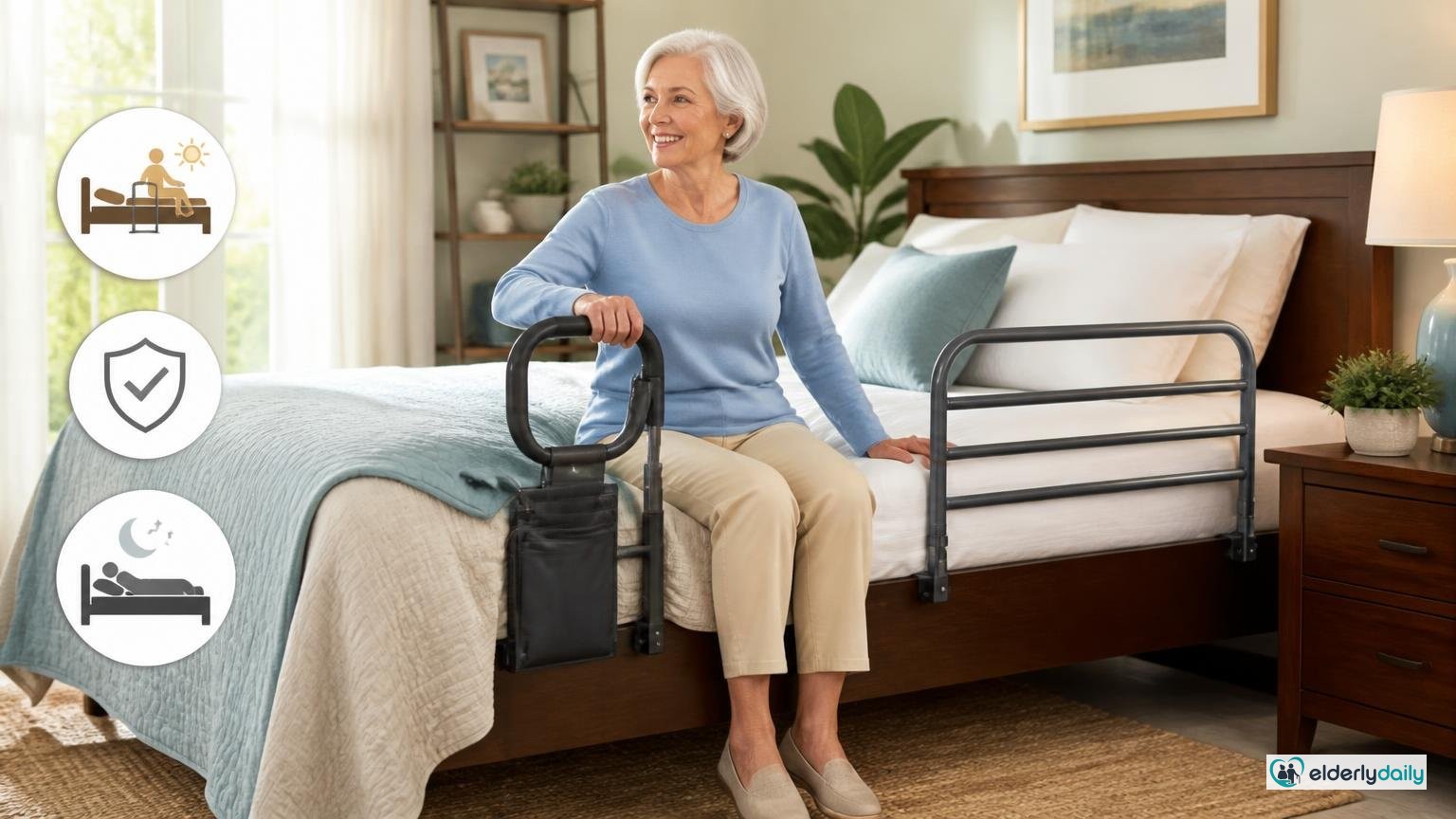
The EZ Adjust extends in length after it is fitted — short as a grab handle for getting out of bed, long as a guard rail for sleeping. That one feature is why it is our top pick, and it is also the thing most listings fail to explain.
Stander markets the EZ Adjust as the only bed rail that extends in length after installation, so it can be short by day and long at night. Push a button and it moves between roughly 26, 34 and 42 inches — short enough to act as a grab handle you swing your legs past in the morning, long enough at night to stop someone rolling out. Most rails force you to pick one of those jobs.
It is also ASTM F3186-17 certified, which matters more than any feature — the voluntary standard covering the openings a bed rail is allowed to have, and openings are the mechanism behind the entrapment injuries that make rails controversial. Plenty of rails on Amazon mention no standard at all.
Fit is where people come unstuck. It needs a mattress 12 to 16 inches thick and about 14 inches of clearance under the bed, and Stander states it is not for adjustable beds or very soft mattresses. Measure all three before ordering. And one thing no retailer page will say: a bed rail is not right for everyone. If the person is confused at night or has dementia, a rail can be climbed over, turning a fall from mattress height into a fall from rail height. Read who should not use a bed rail before buying this or any other.
We may earn a commission when you buy through links on this page, at no extra cost to you. Read our affiliate disclosure.
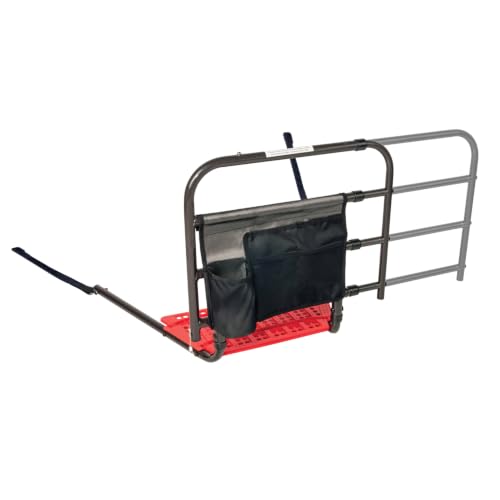
Stander EZ Adjust Bed Rail (Model 8000)
An alert senior on a standard bed who wants a handhold for getting up by day and a longer guard at night
- Extends in length after it is fitted — a short handle by day, a full guard by night, without refitting anything
- ASTM F3186-17 certified, which many rails on Amazon do not state
- Pivots down 180° and rests at the bedside, so bed-making and care do not mean removing it
- Doubles as a support handle for sitting up and standing, not just a barrier
- Reversible — fits either side of the bed
- Organizer pouch keeps a phone, glasses or a remote within reach, which removes one common reason to get up
Certification
ASTM F3186-17 (adult portable bed rails)
Length
Adjusts 26 / 34 / 42 in by push button
Capacity
300 lb
Mattress depth
12–16 in
Folding
Pivots down 180° to the side of the bed
Floor clearance
~14 in needed under the mattress to pivot
Fitting
Slides between mattress and base, plus frame safety strap
Included
Multi-pocket organizer pouch
Not for
**Adjustable beds, or extra-soft mattresses**
What we like
- Extends in length after it is fitted — a short handle by day, a full guard by night, without refitting anything
- ASTM F3186-17 certified, which many rails on Amazon do not state
- Pivots down 180° and rests at the bedside, so bed-making and care do not mean removing it
- Doubles as a support handle for sitting up and standing, not just a barrier
- Reversible — fits either side of the bed
- Organizer pouch keeps a phone, glasses or a remote within reach, which removes one common reason to get up
- Carries a manufacturer warranty, unlike most unbranded rails
Worth noting
- Not for adjustable beds — Stander excludes them, and this rules it out for a lot of households
- Needs a 12–16 inch mattress; thinner or thicker and the fit is wrong
- Needs roughly 14 inches of clearance beneath the mattress for the rail to pivot — low platform beds and storage drawers can block it
- Not for very soft mattresses, because the rail cannot hold a stable gap against foam that compresses
- Anchors between mattress and base rather than to the floor, so it is only as steady as the mattress above it
- Heavier and bulkier than a simple assist handle, and more to store if it is removed
- Stander sells several similarly named rails — easy to buy the wrong one (see below)
Buy it if…
- The bed is a standard one with a box spring, platform or slats, and a mattress 12–16 inches deep
- The person is alert and oriented, and wants leverage getting up as much as a barrier at night
- A caregiver comes to the bedside regularly and needs the rail out of the way
- You want a certified rail rather than the cheapest one that looks similar
- One rail needs to do two jobs — daytime handhold and nighttime guard
Look elsewhere if…
- The bed is an adjustable base — Stander excludes this, and the gap changes as the bed articulates
- The mattress is memory foam or otherwise very soft — the gap will not stay stable
- The person is confused at night or has dementia — see who should not use a bed rail; a fall mat or lower bed is usually safer
- The bed sits low to the floor or has storage drawers, leaving no room for the rail to pivot down
- All that is needed is a handhold to push up from — a bed assist handle is smaller, cheaper and has less to get caught in
The one feature that makes it different
Almost every bed rail asks you to choose. A short one gives you something to grab when you swing your legs out, but does nothing to stop you rolling out at 3am. A long one guards the bed but is a barrier to climb past every time you get up.
The EZ Adjust does not make you choose. Press the button and the guard section telescopes — roughly 26 inches, 34 inches, or 42 inches — while the rail stays attached to the bed. Short in the morning to get up past, long at night for protection.
That is genuinely useful for a specific person: someone whose risk is different by day and by night. Getting out of bed is the risky moment when they are awake; rolling out is the risky moment when they are not. A fixed rail only ever addresses one of those well.
It also pivots down through 180 degrees and folds against the side of the bed, which is what makes it workable when a caregiver is in and out — changing bedding or helping with a transfer does not mean unbolting anything.
If neither of those describes your situation, a simpler rail will do the same job for less. The extension is the reason to pay for this one.
Which Stander rail is this? The names overlap badly
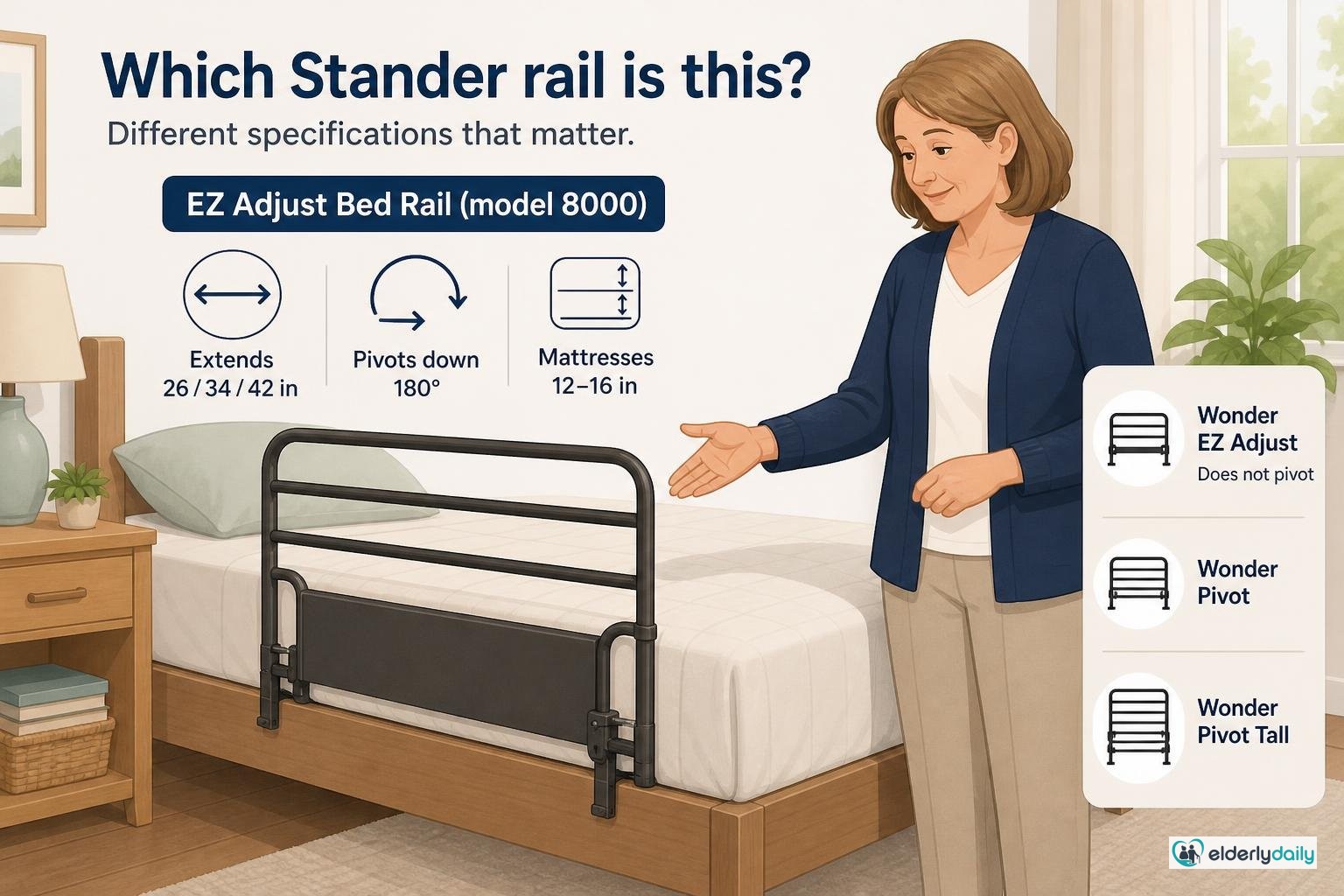
This is the most useful thing an independent review can tell you about this product, because every retailer page describes only the one it sells.
Stander sells several rails with names close enough to confuse, and they have different specifications that matter:
- EZ Adjust Bed Rail (model 8000) — this one. Extends 26 / 34 / 42 in, pivots down 180°, mattresses 12–16 in.
- Wonder EZ Adjust — extends 20–30 in, mattresses 10–14 in, and importantly does not pivot.
- Wonder Pivot — extends 26 / 32 / 38.5 in, pivots, but fits thinner mattresses at 8–12 in.
- Wonder Pivot Tall — the same idea sized for taller mattresses, 8–16 in.
You can see the problem. Three of them fold and one does not; the mattress ranges differ. Someone who measures their mattress at 10 inches, searches for the EZ Adjust because a review recommended it, and buys this one has bought a rail that does not fit their bed.
Check the mattress depth against the specific model before ordering, not against the brand. If your mattress is 12 to 16 inches, this is the right one. If it is thinner, look at the Wonder Pivot instead, which we also cover in the roundup.
The three measurements to take first
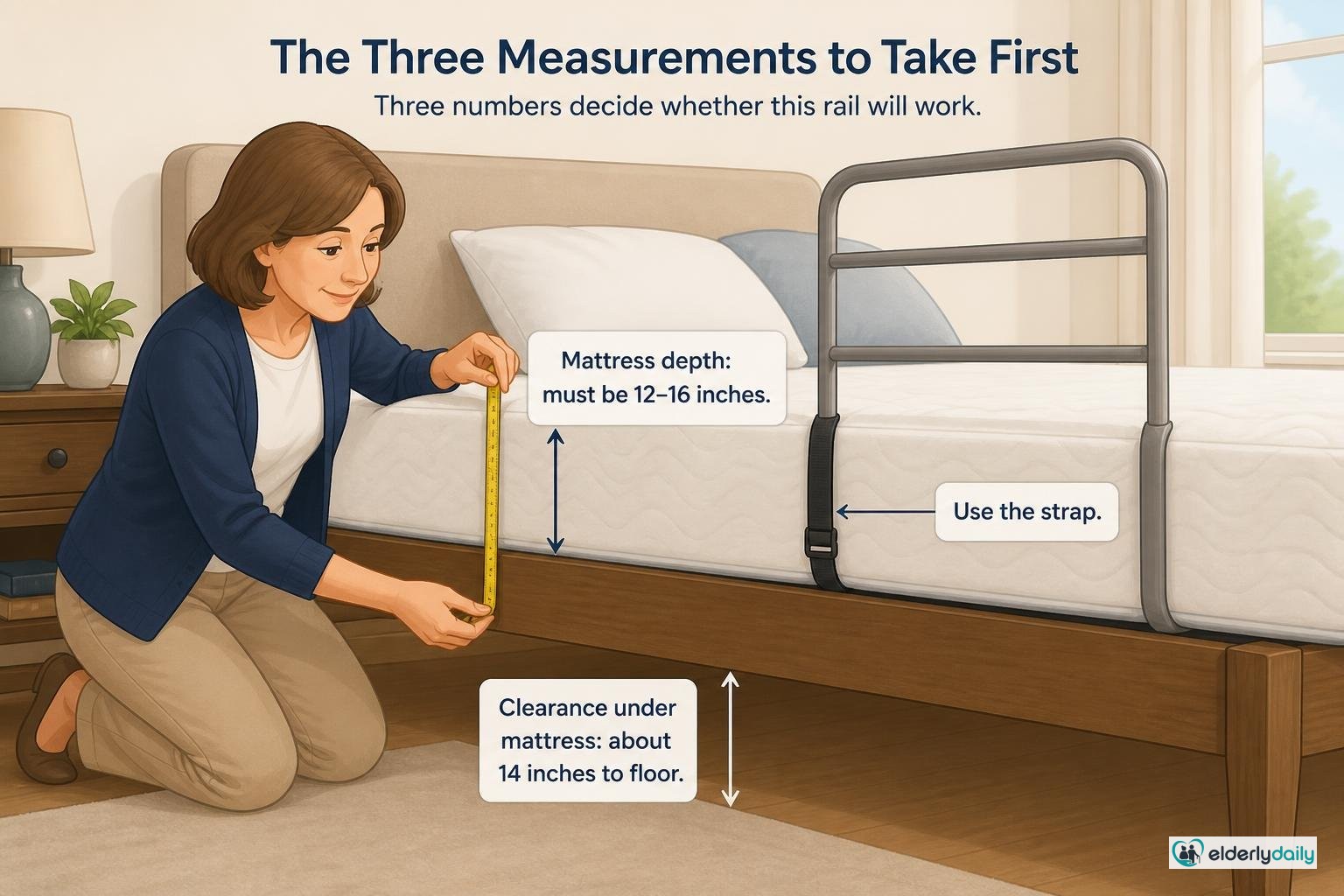
Most bad reviews of any bed rail come down to fit rather than the rail. Three numbers decide whether this one will work, and all three take a tape measure and two minutes.
- Mattress depth: must be 12–16 inches. Measure the mattress alone, not mattress plus base. Too thin and the rail sits proud with a gap beneath it; too thick and it does not reach.
- Clearance under the mattress: about 14 inches to the floor. The rail pivots downward, and it needs somewhere to go. Low platform beds, divans and beds with storage drawers frequently fail this test.
- Bed type: traditional frame with box spring, platform or slats. Not an adjustable base. Not a hospital bed.
Fitting itself is straightforward: the support bars slide between the mattress and the base, and a safety strap wraps the bed frame on the opposite side to stop the whole assembly sliding. Use the strap. It is the part people skip, and it is what stops the rail migrating over weeks of use.
Once it is on, check the gap between the rail and the mattress with the person’s weight in the bed rather than an empty one — a mattress compresses under a body, and the gap you measured empty is not the gap that exists at night.
What ASTM F3186-17 certification actually means
Bed rails have a difficult safety history. The injuries that caused it are entrapment injuries — a head, neck or chest caught in an opening, either between the bars of the rail, between the rail and the mattress, or at the end where the rail stops.
ASTM F3186-17 is the voluntary standard for adult portable bed rails, and what it governs is the size of those openings. A rail tested to it has been measured against limits set to stop a head passing through. The EZ Adjust is certified to it, and Stander is one of relatively few makers that says so on the listing.
That is worth paying for, because the alternative is guessing. A large number of bed rails on Amazon mention no standard whatsoever, and their gap dimensions are whatever the factory chose.
Certification does not make a rail safe on its own, though — it means the rail's openings meet the standard. Fit is still yours to get right, and a certified rail installed with a four-inch gap to the mattress is as dangerous as an uncertified one. Check it after fitting, check it again after the bed has been made a few times, and check it if the mattress is ever replaced.
Our bed rail safety and entrapment guide, reviewed by a physician, covers the fitting checks and the warning signs in full.
When the answer is not a bed rail at all
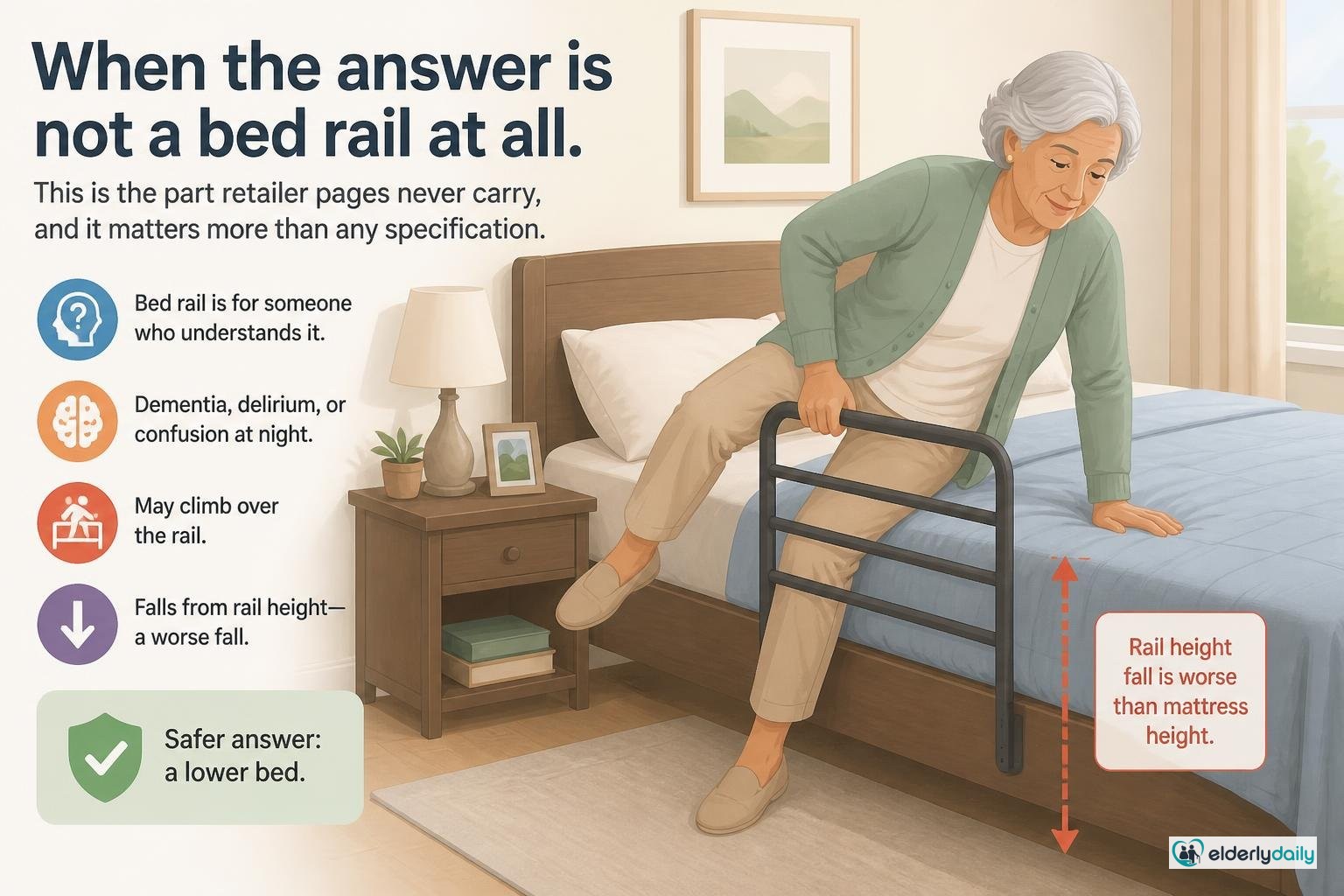
This is the part retailer pages never carry, and it matters more than any specification.
A bed rail is an assist device for someone who can understand what it is. For someone who cannot — through dementia, delirium, or confusion at night — it becomes something to get past. A person determined to get out of bed may climb over the rail, and then falls from rail height rather than mattress height. That is a worse fall, not a prevented one.
The safer answers in that situation are usually a lower bed, a bedside fall mat, and a bed alarm that tells a caregiver someone is up, rather than a barrier that tries to hold them in.
There is also a line worth understanding between an assist rail and a restraint. A rail used to help someone move is an aid. A rail used to stop someone leaving the bed against their wishes is a restraint, and that carries both ethical and, in care settings, legal weight.
If there is any doubt about which situation you are in, an occupational therapist can assess it — and they are also the right people to fit a rail, which our guide explains.
Living with it

A few practical points that matter once the rail is in daily use.
The pouch is more useful than it sounds. Phone, glasses, remote, a glass of water within reach removes a whole category of unnecessary night-time trips — and the trip to fetch something is a fall risk.
Get into a habit with the length. The rail only helps if it is extended at night, and the button is easy to forget. Tying it to another routine — extending it when the light goes off — works better than intending to remember.
The telescoping section and the pivot are moving parts, so check whether noise could bother a light sleeper. For a light sleeper, or someone who wakes confused, that is worth knowing.
Re-check the strap monthly. Straps loosen. It takes ten seconds and it is the difference between a rail that stays put and one that has quietly shifted two inches.
What Stander says
The following are Stander’s own marketing claims from the product listing, not our independent findings. Details can change over time — check the current Stander website for the latest.
- Stander states the EZ Adjust has passed the ASTM F3186-17 Safety Standard for Adult Portable Bed Rails, and advises using only bed rails tested and certified to that standard.
- The company states the guard rail adjusts in length from 26 to 34 to 42 inches, doubles as a support handle for bed entry, exit and repositioning, and supports up to 300 lb.
- Stander describes the rail as folding down 180 degrees and collapsing to the side of the bed to make changing bedding and providing care easier.
- The brand states it attaches to regular homestyle beds with mattresses 12 to 16 inches thick using the safety strap, and is not intended for use on adjustable beds or beds with extra-soft mattresses.
- Stander markets the EZ Adjust as the only bed rail that extends in length after installation, allowing use as a half rail for getting out of bed and a full-length rail at night.
How it compares
The EZ Adjust is our top pick in the bed rails roundup, and the extension is why. The alternatives below are worth considering when the mattress depth rules it out, when a caregiver needs the rail out of the way more often than the user needs a barrier, or when what is really needed is a handhold rather than a guard.
- Stander Wonder Pivot Bed Rail — also ASTM certified and also pivots, but sized for thinner mattresses at 8–12 inches. The one to choose if your mattress is under 12 inches deep.
- KingPavonini BM03-1 — higher capacity at 380 lb and a much wider mattress range of 3–12 inches — the answer for a heavier user or a thin mattress, though it does not extend or fold.
- A bed assist handle — if the need is leverage to sit up and stand rather than a barrier at night, a short handle is cheaper, smaller and has far less to become trapped in.
Frequently asked questions
For the right bed and the right person, yes. It is one of relatively few rails certified to ASTM F3186-17, and the extending length solves a problem that fixed-length rails do not — a short handle for getting up in the morning and a longer guard at night, without refitting anything. It is worth less if your situation only needs one of those jobs, in which case a simpler rail or a bed assist handle costs less and does it just as well. And it is worth nothing at all if the mattress is outside 12 to 16 inches, or the bed is an adjustable base, because it will not fit safely.
The 8000 is the EZ Adjust reviewed here: it extends 26 to 34 to 42 inches, pivots down 180 degrees, and fits mattresses 12 to 16 inches thick. The Wonder EZ Adjust extends 20 to 30 inches, fits 10 to 14 inch mattresses, and does not pivot. The Wonder Pivot extends 26 to 38.5 inches and fits thinner mattresses at 8 to 12 inches, with a Tall version for 8 to 16. The names are close enough that buying the wrong one is easy, and the mattress ranges barely overlap — so check the depth of your own mattress against the specific model rather than trusting the brand name.
No. Stander states plainly that it is not intended for adjustable beds. The reason is worth understanding rather than just obeying: as an adjustable base raises the head or foot, the mattress bends while a rigid rail does not, which opens a gap that was not there when the bed was flat. Moving gaps are exactly the entrapment risk that rail standards exist to control. If the bed articulates, look for a rail sold and tested specifically for adjustable bases, or one supplied by the bed manufacturer.
Twelve to sixteen inches. Measure the mattress alone rather than the mattress and base together, because that is the dimension the rail is designed around. It also needs roughly fourteen inches of clearance from the underside of the mattress to the floor so the rail has room to pivot down — low platform beds, divans and beds with storage drawers often fail that second test even when the mattress depth is right. Stander also advises against very soft mattresses, because foam that compresses will not hold a stable gap.
At its full 42-inch extension it acts as a guard rail along more of the bed, but no rail can promise to stop someone from falling out. What it cannot do is stop someone who decides to get out. A person who is confused or restless may climb over it, and a fall from rail height is worse than a fall from mattress height. That is why a rail is the right answer for some people and the wrong one for others, and why our bed rail safety guide spends as much time on who should not use one as on fitting.
Stander rates it at 300 lb. That is typical for a rail of this type and adequate for most users, but it is a real limit rather than a guideline — a rail is something people put their full weight through when standing, often suddenly. If the person is near or above that figure, look at a higher-capacity model; the KingPavonini in our roundup is rated to 380 lb.
No, and no tools are needed. The support bars slide between the mattress and the base, and a safety strap wraps around the bed frame on the opposite side. The strap is the part people skip and the part that matters most — without it the whole assembly can migrate over weeks of use. Fit it, then check the gap between rail and mattress with someone actually lying in the bed, because a mattress compresses under a body and the gap you measure on an empty bed is not the gap that exists at night.
Stander EZ Adjust Bed Rail (Model 8000)
Best for: An alert senior on a standard bed who wants a handhold for getting up by day and a longer guard at night
