
Withings BPM Connect Review: Accurate, Hands-Off, and Right for Some Older Adults
 By SK Kutubuddin, Founder & Senior Care Researcher Updated October 26, 2026
In this guide
- Pros and cons
- What the BPM Connect is, and what it is not
- Is the Withings BPM Connect accurate?
- What it is like for an older adult to use
- Sharing readings with family and the doctor
- The 3-reading mode
- How to take an accurate reading at home
- Check the arm size before buying
- BPM Connect vs BPM Vision and Omron
- Who should buy it
- What Withings says
- How it compares
- Frequently asked questions
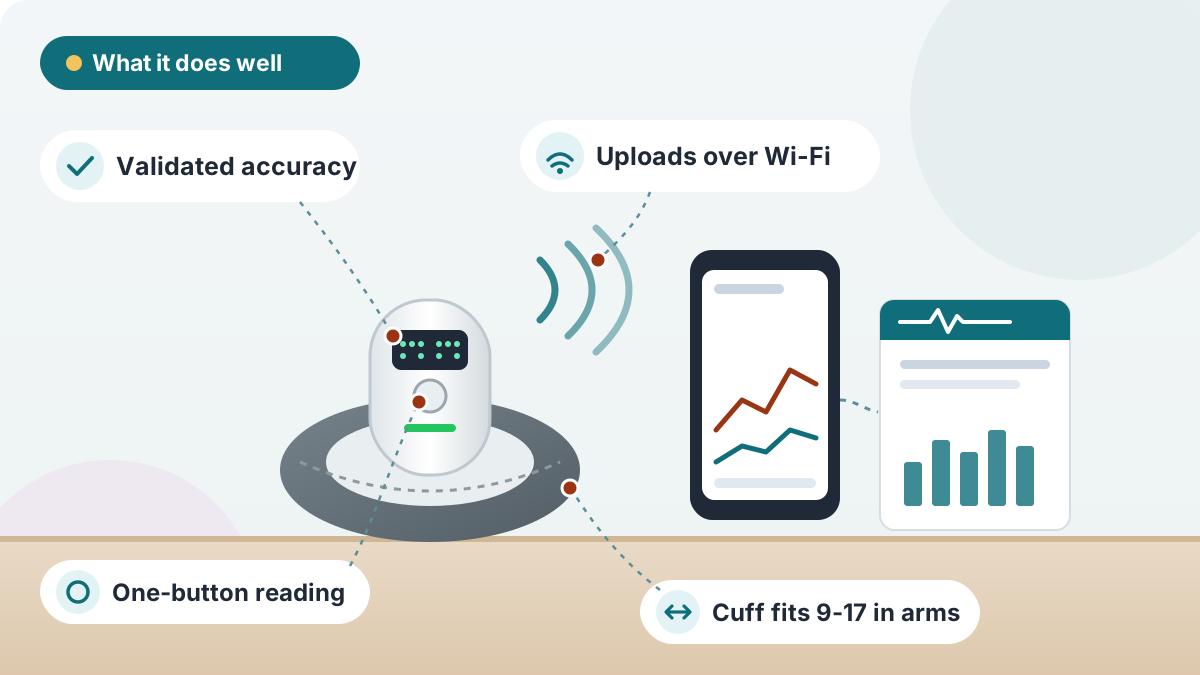
The BPM Connect does the most important job well: it is on the American Medical Association's Validated Device Listing, tested to the international ISO 81060-2 accuracy standard, so its readings can be trusted when it is used properly. What sets it apart is what happens next. Once it is set up, every reading travels over Wi-Fi to the Withings app on its own, so a daughter in another city, or a doctor adjusting medication, can see the numbers without the person being measured opening an app, keeping a paper log or even having their phone nearby.
For an older adult that is a real advantage, with real limits. It needs a smartphone and the Withings app to set it up (iOS 18 or Android 12 and later), so someone comfortable with phones has to do the installation. Its display is a small dot-matrix screen rather than large digits. Its one-size cuff fits arms from 9 to 17 inches and cannot be swapped for a larger one. And Withings lists only blood pressure and heart rate, with no irregular-heartbeat or AFib flag, which some Omron monitors include.
Buy it if the main problem is getting readings to family or the doctor. If the person will take readings alone and just wants big, clear numbers, a simpler validated monitor from our blood pressure monitor roundup will suit them better, and usually costs less.
We may earn a commission when you buy through links on this page, at no extra cost to you. Read our affiliate disclosure.

Withings BPM Connect (WPM05)
An older adult whose readings a family member or doctor wants to see, without anyone writing them down
- On the AMA's Validated Device Listing, tested to the ISO 81060-2 standard
- Readings upload over Wi-Fi by themselves, with no app to open and no log to keep
- Easy to share a PDF report or live readings with a doctor or family member
- One button, and a colour light that shows at a glance whether a reading is normal or high
- A 3-reading mode that averages three measurements automatically
- Rechargeable battery, about 6 months a charge, so no AA batteries to change
Type
Upper-arm, automatic (oscillometric)
Validation
On the AMA Validated Device Listing (ISO 81060-2)
Cuff
Integrated, one size: 22-42 cm (9-17 in) arms
Measures
Systolic, diastolic, heart rate
Display
LED dot-matrix screen plus colour-coded light
Sync
Wi-Fi and Bluetooth to the Withings app
Memory
8 readings on the device between syncs; unlimited in the app
Users
Up to 8 profiles
Power
Rechargeable, about 6 months per charge (per Withings)
Size
6.1 x 2.6 x 2 in, 250 g (about 9 oz)
Warranty
2 years; FSA/HSA eligible
What we like
- On the AMA's Validated Device Listing, tested to the ISO 81060-2 standard
- Readings upload over Wi-Fi by themselves, with no app to open and no log to keep
- Easy to share a PDF report or live readings with a doctor or family member
- One button, and a colour light that shows at a glance whether a reading is normal or high
- A 3-reading mode that averages three measurements automatically
- Rechargeable battery, about 6 months a charge, so no AA batteries to change
- Small and light enough to travel
Worth noting
- Setup needs a smartphone and the Withings app (iOS 18 or Android 12 and later), so many older adults will need help to install it
- The dot-matrix display is small and less readable than the large digits on many simpler monitors
- One integrated cuff for 9-17 inch arms only; there is no larger cuff for this model
- No irregular-heartbeat or AFib flag listed, unlike some Omron monitors
- Assigning a reading to the right person means cycling through names with the single button, which is fiddly in a two-person household
- Pricier than a basic validated monitor that does the measuring just as accurately
Buy it if…
- A family member or doctor wants to see readings regularly, without relying on a written log
- Someone in the family can set it up on a smartphone and keep an eye on the app
- The person being measured is comfortable pressing one button and little else
- The upper arm measures between 9 and 17 inches
- The doctor is adjusting blood pressure medication and has asked for home readings
Look elsewhere if…
- Nobody in the household uses a smartphone: setup requires one
- The person mainly needs large, easy-to-read numbers on the device itself
- The upper arm is larger than 17 inches: see the larger-cuff options below
- The person has a pacemaker or an implanted defibrillator: Withings says readings may be inconclusive
- You want an irregular-heartbeat or AFib warning with each reading
- You want the most accurate reading for the least money: validated monitors start far cheaper
What the BPM Connect is, and what it is not
The BPM Connect is an automatic upper-arm blood pressure monitor built into a small cylinder, about six inches long, that is joined to its cuff. You wrap the cuff around the bare upper arm, rest the arm on a table, and press the single button. It inflates, measures, and shows the systolic and diastolic pressure and the heart rate on a small LED dot-matrix screen, with a coloured light that shows at a glance whether the reading is in the normal or high range.
What makes it different from most home monitors is what happens after the reading. It connects to home Wi-Fi as well as Bluetooth, so readings upload to the Withings app by themselves, even if the phone is in another room or another town. The device holds up to eight readings if it cannot connect, then sends them on next time it can.
It is not an ECG device, and Withings lists only blood pressure and heart rate among the things it measures, with no irregular-heartbeat or atrial fibrillation (AFib) flag. It is also not a cellular device: a version called the BPM Connect Pro, made for doctors' remote-monitoring programmes, sends readings over the mobile network without home Wi-Fi.
Is the Withings BPM Connect accurate?
Yes, when it is used properly. Accuracy is the one thing a blood pressure monitor cannot get wrong, and it is the first thing to check. The BPM Connect (model WPM05) is on the Validated Device Listing run by the American Medical Association, which only includes monitors validated for clinical accuracy. Its listing names the ANSI/AAMI/ISO 81060-2 standard, an arm range of 22 to 42 cm, and validation for adults in general and in pregnancy.
The published validation study, in the journal *Vascular Health and Risk Management* in 2022, tested it against the international standard in 85 people. On average its readings differed from reference measurements by 0.6 mmHg systolic and 2.1 mmHg diastolic, well inside the standard's limit of 5 mmHg, and it passed every criterion of the standard. The study was in the general population rather than specifically in older adults.
Two cautions. Withings says readings may be inconclusive for anyone with a pacemaker or an implanted cardioverter defibrillator. And no monitor is more accurate than the way it is used: a cuff on top of a sleeve, a reading taken straight after walking upstairs, or an arm hanging by the side can each push the numbers up by more than any difference between good monitors.
What it is like for an older adult to use
Day to day, it is simple: cuff on, arm on the table, one press of the button. There is nothing to plug in, and no tube to connect, because the cuff and the monitor are one piece. The battery is rechargeable, and Withings says a charge lasts about six months, with the battery level shown in the app, so there are no small batteries to find and change.
Three things are harder than they need to be for an older user:
- Setup. Installing it requires the Withings app on a smartphone (iOS 18 or Android 12 and later) and the home Wi-Fi password. It cannot be set up from a computer. In practice, a family member or carer will usually do this once.
- The display. The reading appears on a small LED dot-matrix screen on the end of the cylinder. It is bright, but the figures are much smaller than the large digits on many simpler monitors. The coloured light helps: green for normal readings, orange for high-normal and red for high blood pressure, according to Withings.
- More than one user. Up to eight people can use one monitor, but after each reading you have to cycle through the names with the single button and hold it to assign the reading. That is easy to get wrong, so a couple sharing one monitor should practise it together.
If the person being measured lives alone and will not ask for help with the setup, that is a reason to choose a simpler monitor rather than a reason to struggle with this one.
Sharing readings with family and the doctor
This is the reason to buy a BPM Connect. Once set up, readings arrive in the Withings app by themselves, so a family member can see whether a parent is measuring and what the numbers are, without phoning to ask. Withings says the app can securely share data, produce a PDF report to send to a doctor, and show a live dashboard during a video appointment.
That matters most when a doctor is adjusting blood pressure medication and has asked for home readings. A complete record of every reading, with times, is more useful than a handwritten list with gaps, and more honest than one where the high readings were left out.
Remember that the doctor will not see the readings unless someone shares them. Agree in advance how the readings will reach the surgery: a PDF before each appointment, or whatever their own system accepts.
The 3-reading mode
Single readings vary, which is why the American Heart Association advises taking two readings a minute apart and recording both. The BPM Connect has an automatic mode that takes three readings in a row and shows only their average. To use it, press the button to switch it on, then press and hold until the screen shows BP x3, and press again to start. The gap between readings is set in the app.
Withings says that, because of an FDA requirement, this mode has to be selected each time it is used. For an older adult that is one more step to remember, but it is worth learning: an average of three readings is a better guide to treatment than one.
How to take an accurate reading at home
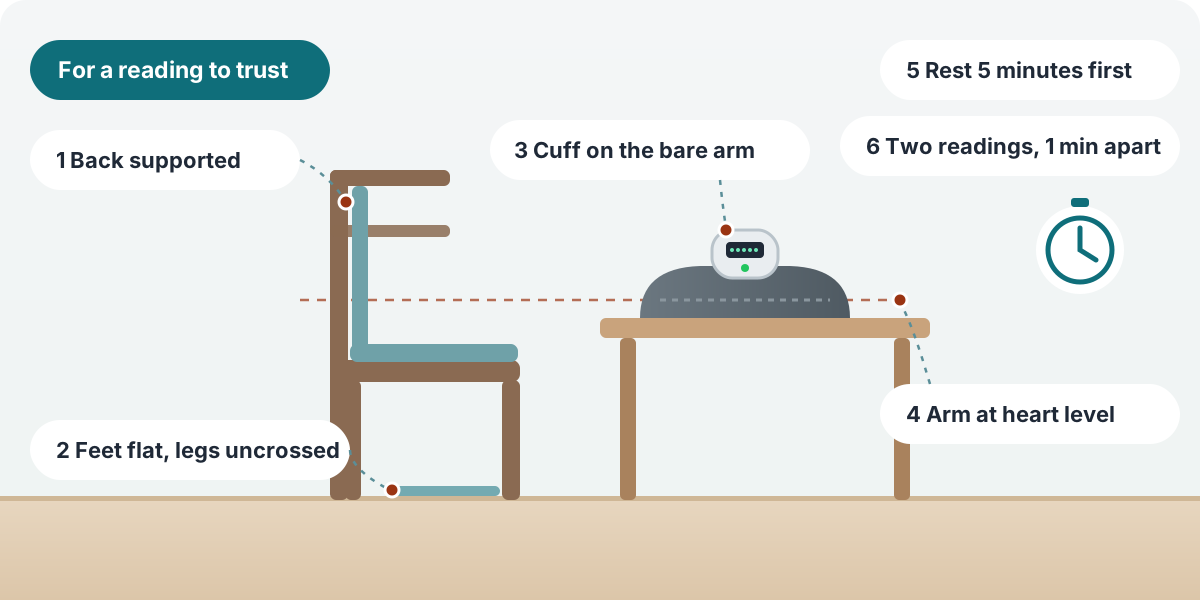
These steps come from the American Heart Association, and they matter as much as the monitor:
- No caffeine, smoking or exercise for 30 minutes before, and empty the bladder first
- Sit in a dining chair rather than a sofa, back supported, feet flat and legs uncrossed
- Rest quietly for five minutes, without talking or looking at a phone
- Put the cuff on the bare upper arm, never over a sleeve
- Rest the arm on a table so the cuff is at heart level
- Take two readings a minute apart (or use the BPM Connect's 3-reading mode), at the same times each day
- Have the monitor checked against the equipment at the doctor's office, typically once a year
The AHA also gives the reading to act on: higher than 180 systolic and/or 120 diastolic is a hypertensive crisis. Wait a few minutes and measure again, and if it is still that high, contact a doctor straight away. If it comes with chest pain, breathlessness, weakness, numbness, vision changes or difficulty speaking, call 911.
Check the arm size before buying
A cuff that is the wrong size gives the wrong reading, and the BPM Connect has one cuff, built in. It fits upper arms from 22 to 42 cm (about 9 to 17 inches) around, measured midway between the shoulder and the elbow. That covers most adults, but not everyone, and there is no larger cuff for this model.
For an arm larger than 17 inches, choose a monitor with a larger cuff. Withings sells an XL cuff (40 to 52 cm) for its BPM Vision, and the Greater Goods XL-cuff monitor is listed for arms from 15.7 to 20.5 inches. Our roundup covers more options.
BPM Connect vs BPM Vision and Omron
The closest alternatives are Withings' own BPM Vision, which adds a larger screen, and Omron's Bluetooth monitors, which are cheaper and include a heartbeat check. All of these figures come from the makers' Amazon listings and, for the two Withings models, Withings' own comparison page.
| Withings BPM Connect | Withings BPM Vision | Omron Platinum | Omron Evolv | |
|---|---|---|---|---|
| Display | Small LED dot-matrix + colour light | 2.8 in colour LCD | Not stated in listing | Not stated in listing |
| Sync | Wi-Fi + Bluetooth (automatic) | Wi-Fi + Bluetooth (automatic) | Bluetooth (Omron Connect app) | Bluetooth (Omron Connect app) |
| Cuff | 9-17 in, built in | 9-17 in standard; XL cuff sold separately | 9-17 in wide-range D-ring | 9-17 in, attached |
| Heartbeat check | Not listed | Not listed | AFib detection | Irregular heartbeat detection |
| Power | Rechargeable, about 6 months | Rechargeable, about 1 year | 4 AA or AC adapter (included) | 4 AAA |
| On-device help | No | Built-in tutorials | No | No |
Who should buy it
Choose the BPM Connect when the readings need to reach someone else: an adult child keeping an eye on a parent's blood pressure from a distance, or a doctor who has asked for home readings while adjusting medication. Its validated accuracy and hands-off Wi-Fi upload do that better than monitors that rely on a Bluetooth phone app being opened.
Choose the BPM Vision instead if you want the same automatic syncing with a larger, clearer screen and on-device instructions. Choose an Omron such as the Platinum if an AFib check matters, or because the person is used to AA batteries and a bigger display. And if nobody will ever look at the readings except the person taking them, a simple validated monitor with large digits is the better buy.
What Withings says
The following are Withings’s own marketing claims from the product listing, not our independent findings. Details can change over time — check the current Amazon listing for the latest.
- Withings' Amazon listing describes the BPM Connect as "one of the most accurate blood pressure monitors" and says it is FDA cleared and FSA/HSA eligible.
- Withings states that the battery lasts up to 6 months per charge, that the device stores up to 8 readings between syncs with unlimited storage in the Withings app, and that up to eight people can use one monitor.
- Withings says the BPM Connect was tested in a clinical study following European Society of Hypertension, AAMI and ISO protocols, and that results can be shared with a doctor as a PDF report or through a live dashboard during video appointments.
- Withings states that pacemakers and implantable cardioverter defibrillators (ICDs) can make readings inconclusive.
How it compares
The BPM Connect is the pick for sharing readings, not for reading them. Each alternative below solves a different problem, and all are covered in our blood pressure monitor roundup.
- Omron Evolv — a one-piece Bluetooth monitor with an irregular-heartbeat check, our simplest-to-use pick and usually cheaper.
- Omron Complete — our top pick: blood pressure plus a single-lead EKG that can flag AFib in the same session.
- Beurer BM67 — for an older adult who mainly needs big numbers that are easy to read.
Frequently asked questions
Yes. It is on the American Medical Association's Validated Device Listing (validatebp.org), tested to the ANSI/AAMI/ISO 81060-2 standard, and a 2022 validation study in 85 people found average differences from reference readings of 0.6 mmHg systolic and 2.1 mmHg diastolic, inside the standard's limits. Accuracy at home still depends on the right cuff size and good technique.
It is good for older adults whose readings need to reach family or a doctor, because readings upload over Wi-Fi by themselves. It is less suitable for someone who will use it entirely alone: setup needs a smartphone, the display is small, and the cuff only fits 9 to 17 inch arms.
Not entirely. It has to be set up through the Withings app on a smartphone. After that it measures and shows the result on its own screen, and uploads over Wi-Fi without the phone needing to be nearby. Without a phone or app, you lose the history and the sharing, which are the reasons to buy it.
Upper arms from 22 to 42 cm, about 9 to 17 inches around, measured midway between shoulder and elbow. The cuff is built in, so there is no larger option for this model. For bigger arms, the BPM Vision has an optional XL cuff (40 to 52 cm), and there are other XL-cuff monitors in our roundup.
Withings lists only systolic and diastolic blood pressure and heart rate. It does not advertise irregular-heartbeat or AFib detection. If that matters, the Omron Platinum lists AFib detection and the Omron Complete adds a single-lead EKG.
Up to eight. After each reading you cycle through the names with the button and hold it to assign the reading to the right person. It is worth practising, because a reading saved to the wrong person spoils both records.
Withings says up to six months per charge. It recharges with the supplied USB cable, and the app shows the battery level. An orange light can also mean the battery is low, though you can still take a reading.
Both are validated Withings monitors that sync over Wi-Fi and Bluetooth. The BPM Vision adds a 2.8-inch colour LCD screen, built-in tutorials, a case that doubles as a stand, a battery Withings rates at about a year, and an optional XL cuff. The BPM Connect is smaller and cheaper, with a small LED dot-matrix display.
A version made for doctors' remote patient monitoring programmes. It sends readings over the mobile phone network, so it does not need home Wi-Fi or a smartphone. It is usually supplied through a healthcare provider's programme rather than bought for home use.
Withings says pacemakers and implantable cardioverter defibrillators can make readings inconclusive. Ask the cardiologist which home monitor and method they recommend.
According to Withings, green means a normal reading, orange a high-normal reading and red high blood pressure. Withings notes that the categories can vary by country's guidelines, and the same colours are also used for setup and battery messages, so check the number as well as the colour.
Withings BPM Connect (WPM05)
Best for: An older adult whose readings a family member or doctor wants to see, without anyone writing them down
More reviews
