
6 Best Compression Socks for Seniors
 By SK Kutubuddin, Founder & Senior Care Researcher Updated October 2026
In this guide
 Best OverallSockwell Circulator Compression Socks
 Best Zipper SocksCASMON Zipper Compression Socks
 Best Mild CompressionDr. Scholl's Graduated Mild Compression Socks
 Best Wide CalfPembrook Wide Calf Compression Socks
 Best Open ToeJOBST Relief Open Toe Compression Socks
 Best Medical-Style ValueTruform 15-20 mmHg Knee High Stockings
- What to look for
- Frequently asked questions
The best compression sock for an older adult is the one they can get on and will keep wearing, at a strength that is safe for their legs.
We may earn a commission when you buy through links on this page. Read our affiliate disclosure.
On sale now

COMFIER 2026 FSA Wireless Hand Massager with Heat
$49.99-34%Prime members


Prices from Amazon as of Oct 26, 5:15 AM ET. They can change; the price on Amazon when you buy is the one that applies. Affiliate links — we may earn a commission.
Top 6 Picks — Find Your Situation
#1 · Best Overall
Sockwell Circulator Compression SocksBest for: Everyday wear for tired, achy or mildly swollen legs
#2 · Best Zipper Socks
CASMON Zipper Compression SocksBest for: Stiff hands, a bad back or swollen ankles that make pulling socks on hard
#3 · Best Mild Compression
Dr. Scholl's Graduated Mild Compression SocksBest for: First-time wearers, travel, and long periods of sitting
#4 · Best Wide Calf
Pembrook Wide Calf Compression SocksBest for: Larger or swollen calves that standard sizes squeeze
#5 · Best Open Toe
JOBST Relief Open Toe Compression SocksBest for: Bunions, sensitive toes, or anyone whose toes need checking during the day
#6 · Best Medical-Style Value
Truform 15-20 mmHg Knee High StockingsBest for: A doctor-suggested 15 to 20 mmHg sock at a low price
For most people that means moderate compression (15 to 20 mmHg), and our overall pick, the Sockwell Circulator, delivers it in a soft wool-based blend. If pulling socks on is the problem, the CASMON Zipper Socks zip up the side; for a first pair, the mild Dr. Scholl's (8 to 15 mmHg) is the easiest to get on; and for larger calves, the Pembrook Wide Calf goes up to a 23-inch calf. One check matters more than any of these: compression is not safe for everyone. Poor circulation in the legs (peripheral artery disease) and neuropathy are both on the NHS list of reasons not to wear compression stockings without a clinician's assessment, so read the safety section before buying.
A closer look at our top pick
Sockwell Circulator Compression Socks
Best for: Everyday wear for tired, achy or mildly swollen legs
- Strength
- 15 to 20 mmHg (moderate)
- Length
- Knee high
- Toe
- Closed
- Material
- Wool-based blend
Independently researched · Updated October 2026
The most effective compression sock is the one that is actually worn, and older adults often abandon medical stockings because they are hot, scratchy and hard to get on. The Sockwell Circulator is built to avoid that: wool-based yarns that the listing says wick moisture and regulate temperature, and (per Sockwell's men's listing) a seamless toe and light cushioning.
Its moderate 15 to 20 mmHg graduated compression is the level most older adults should start with: enough to help tired, puffy legs, without the force of a firm 20 to 30 mmHg medical stocking.
What we love
- Comfortable enough to wear every day
- Wool-based yarns wick moisture and regulate temperature
- Seamless toe, per the men's listing
- Women's version made in the USA, per the listing
Things to consider
- No zipper or easy-on design; pair it with a compression sock aid if bending or grip is hard
- Sold in shoe-size bands (such as M/L) rather than by calf measurement, so check the size chart
Right for you if
- ✓Tired, achy or mildly swollen legs by the end of the day
- ✓You want a sock that looks and feels like a normal sock
- ✓They can pull on a snug sock, or have a sock aid
Maybe skip it if
- !Pulling socks on is impossible: choose the CASMON zipper socks
- !Calves over 17 to 18 inches: the Pembrook Wide Calf fits up to 23 inches
- !A doctor has prescribed 20 to 30 mmHg or higher
- !Poor leg circulation, neuropathy or heart failure: get checked before any compression sock
- !You want a product tested hands-on; we research listings and published guidance, and we say so
Getting started
- →Check the size chart against their shoe size, and size up if between sizes
- →Put them on first thing in the morning, before the legs swell
- →Smooth out every crease; never fold the top over
- →Check the legs and feet each evening for marks or red areas
How it compares
Our #2 pick, the CASMON Zipper Socks, give the same moderate 15 to 20 mmHg compression but zip up the side, so there is no pulling over the heel. Choose the Sockwell for comfort and everyday wear, the CASMON if getting socks on is the main problem.
How we picked
We compared 10 compression socks from the Amazon Deals Hub plus dozens more from Amazon searches for the styles older adults look for (zipper, wide calf, open toe and mild compression), against what matters most for older legs: a compression level that is clearly stated and not too firm, a way to put them on with weak hands or a stiff back, sizing that fits the calf, comfort for all-day wear, and honest claims. Every product detail on this page comes from the product's own Amazon listing, pulled through Amazon's product API on 26 October 2026. Safety guidance comes from NHS compression hosiery guidelines and published research, cited where it appears. We did not test these socks hands-on, and we flag listing claims that go beyond the evidence.
Reviewed by SK Kutubuddin — who researches senior-care products and the real-world needs of caregivers and older adults.
Other picks, reviewed
CASMON Zipper Compression Socks
For anyone who cannot pull a compression sock over the heel. A YKK zipper runs up the side, there is a strip of fabric behind it so the teeth do not rub the skin, and the listing describes an extended pull handle to make the zip easier to grip. The compression is moderate (15 to 20 mmHg) and graduated, strongest at the ankle, and the toe is closed. It is sold as a single pair.
What we like
- Zips on instead of being pulled over the heel
- Fabric guard behind the zipper protects the skin
- Extended handle for an easier grip
- Closed toe
Keep in mind
- The foot still has to go in first, and the zip still needs some grip; a carer may need to help
- Check the skin under the zipper each evening, especially on fragile skin
- Hand wash only, per the listing
- Strength
- 15 to 20 mmHg (moderate)
- Length
- Knee high
- Toe
- Closed
- Material
- Not stated
- Easy-on feature
- Side YKK zipper with pull handle
Dr. Scholl's Graduated Mild Compression Socks
The gentlest starting point, and the easiest to get on. At 8 to 15 mmHg they feel close to an ordinary snug sock, while still graduating from the ankle up. The listing says they carry the American Podiatric Medical Association (APMA) Seal of Acceptance, they have a stay-up top that does not bind, and a smooth toe seam. This is the women's 2-pair pack; men's versions are sold separately.
What we like
- Mildest compression here, easiest to put on
- APMA accepted, per the listing
- Non-binding stay-up top
- Sold by Amazon
Keep in mind
- Too light for medically diagnosed swelling or vein disease, where a doctor may advise firmer socks
- Shoe-size sizing only (women's 4 to 10)
- Strength
- 8 to 15 mmHg (mild)
- Length
- Knee high
- Toe
- Closed, smooth seam
- Material
- Cotton-free, moisture-wicking
- Easy-on feature
- Mild compression, easy to pull on
Pembrook Wide Calf Compression Socks
Standard compression socks cut into wide or swollen calves, which makes them painful and leaves a tight band below the knee. Pembrook sizes these by calf measurement, from XL (calf 15 to 17 in) to 4XL (calf 21 to 23 in), with moderate 15 to 20 mmHg compression in a bamboo viscose blend that the listing says wicks moisture. It comes as a pack of 3 pairs.
What we like
- Sized by calf circumference, up to 23 in
- Moderate compression rather than firm
- 3 pairs, so one can be in the wash
- Moisture-wicking bamboo blend
Keep in mind
- Calves above 23 in need a different brand: VOMFIT makes a 20 to 30 mmHg sock for calves up to 26 in, but that is a firm level to agree with a doctor
- No easy-on feature
- Strength
- 15 to 20 mmHg (moderate)
- Length
- Knee high
- Toe
- Closed
- Material
- Bamboo viscose blend
- Fits
- Calf 15 to 23 in (XL to 4XL)
JOBST Relief Open Toe Compression Socks
From one of the longest-established medical compression brands. The open toe means no pressure on bunions, hammer toes or sore nails, toes can be checked without taking the sock off, and many people find an open-toe sock easier to get on. Compression is 15 to 20 mmHg, graduated from the ankle, in a soft nylon and spandex knit with a reinforced heel pocket. The listing notes that the stated compression is the average for an average ankle and advises asking a healthcare professional if unsure.
What we like
- Open toe takes pressure off bunions and nails
- Toes can be checked without removing the sock
- Established medical compression brand
- Sold by Amazon
Keep in mind
- Open toe means cold toes in winter; wear a thin sock over it if needed
- Synthetic knit is less soft than the Sockwell wool blend
- Strength
- 15 to 20 mmHg (moderate)
- Length
- Knee high
- Toe
- Open
- Material
- Nylon and spandex
- Easy-on feature
- Open toe
Truform 15-20 mmHg Knee High Stockings
A plain, inexpensive medical support stocking from a long-standing compression maker, sized by measuring against Truform's size chart rather than by shoe size alone, which gives a more accurate fit. It has 15 to 20 mmHg graduated compression, a soft top that the listing says will not constrict the leg, a defined heel and a roomy toe for sensitive feet. It is latex-free and made in the USA.
What we like
- Sized by measuring, not shoe size alone
- Latex-free, made in the USA
- Soft, non-constricting top
- Inexpensive and sold by Amazon
Keep in mind
- The listing says it helps treat “DVT blood clots” and calls it anti-embolism; a blood clot needs a doctor, not a store-bought sock
- Medical-style knit is firmer to pull on than the Sockwell or Dr. Scholl's
- Strength
- 15 to 20 mmHg (moderate)
- Length
- Knee high
- Toe
- Closed, roomy
- Material
- Nylon and spandex, latex-free
- Fits
- Sized by measurement chart
What to look for
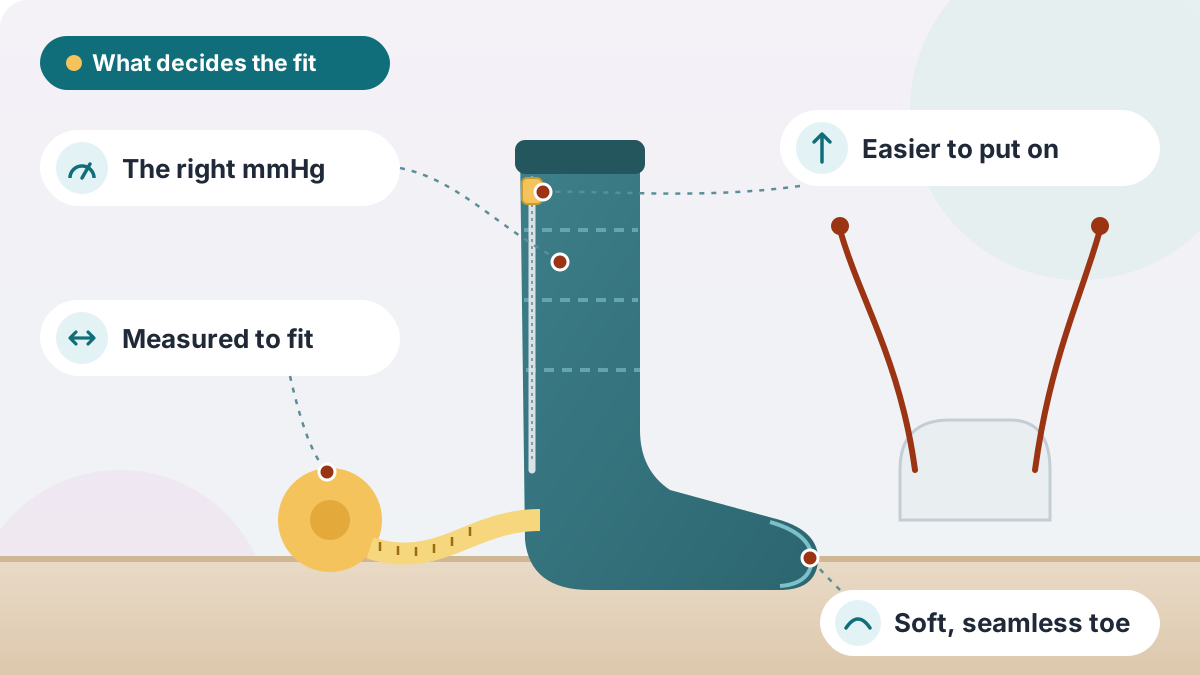
Choosing the strength (mmHg)
Compression is measured in millimetres of mercury (mmHg), and graduated socks are tightest at the ankle and looser towards the knee. The ranges you will see on Amazon:
- 8 to 15 mmHg (mild): close to a snug ordinary sock; for travel, long periods of sitting and tired legs
- 15 to 20 mmHg (moderate): the everyday choice for achy, mildly swollen legs, and where most older adults should start
- 20 to 30 mmHg (firm): usually for diagnosed swelling or vein problems; agree this with a doctor
- 30 to 40 mmHg and above: medical levels that a clinician should choose and fit
Firmer is not better. A sock that is too tight, or that cannot be got on properly and ends up rolled or creased, can do harm. Start mild or moderate unless a doctor has told you otherwise.
Getting them on: the real problem for older adults
The hardest part of compression socks in later life is not choosing them, it is putting them on. Some ways to make it easier:
- Put them on first thing in the morning, before getting up and walking around, when the legs are least swollen
- Choose a zipper style (our CASMON pick), an open toe (JOBST) or a mild level (Dr. Scholl's)
- Use a sock aid made for compression socks; a regular sock aid may not stretch a compression sock wide enough
- Turn the sock inside out down to the heel, put the foot in, then ease it up the leg in sections
- Rubber gloves give extra grip to smooth out creases
- Never roll or fold the top over: a rolled band acts like a tourniquet
Measuring for the right size
Compression only works if the sock fits. Sizing by shoe size alone is a rough guide; the better brands size by ankle and calf measurement. Measure the narrowest part of the ankle and the widest part of the calf first thing in the morning. If the calf is larger than a standard size allows, choose a wide-calf sock (our Pembrook pick goes to a 23-inch calf) rather than squeezing into one that digs in below the knee.
Open toe or closed toe?
A closed toe is warmer and looks like an ordinary sock. An open toe takes pressure off bunions, hammer toes and sore nails, lets toes be checked without removing the sock, and is easier for some people to put on. Both give the same compression on the leg.
Who should check with a doctor before wearing compression socks
Compression socks are safe for most people, but they squeeze the leg, and in some conditions that can do real harm. NHS compression hosiery guidelines list these as reasons not to wear compression stockings until a clinician has assessed the person:
- Known or suspected peripheral artery disease (poor blood supply to the legs: cold, pale feet, cramping pain on walking)
- Peripheral neuropathy or other loss of feeling in the legs or feet, because the person may not feel a sock that is too tight
- Fragile skin, dermatitis, skin grafts or ulcers on the legs
- Previous bypass surgery on the leg arteries
- Very unusually shaped or sized legs that a standard sock cannot fit
The same guidelines advise caution with heart failure until a full assessment has been done. Doctors and nurses check whether compression is safe with a simple test that compares blood pressure at the ankle and the arm (the ankle-brachial pressure index). If any of the above applies, ask for that check first.
Take the socks off straight away and get advice if there is numbness, pins and needles, pain, or the skin looks blue, purple or cold.
Compression socks, diabetes and neuropathy
Two different things are often confused. Diabetic socks are loose, non-binding, cushioned socks designed to protect the feet; they apply no real compression. Compression socks squeeze the leg to help with swelling.
For people with diabetes, a 2012 pilot study in the Journal of Diabetes Science and Technology found that mild compression (18 to 25 mmHg) reduced leg swelling over four weeks without harming circulation, in adults whose leg circulation had been checked first. But neuropathy, which is common with diabetes, is one of the conditions where NHS guidance says compression stockings should not be used without an assessment, because the person may not feel a sock that is too tight. So for anyone with diabetes or neuropathy: get the circulation check first, start with mild compression, and check the feet and legs every evening.
Swelling (edema): when socks help and when to see a doctor
Ankle swelling that goes down overnight and is worse after sitting or standing is common in later life, and compression often helps. But swelling is also a symptom of heart, kidney and liver problems and of blood clots, and some of those make compression unsafe. See a doctor before relying on socks if the swelling is new, is in one leg only, is painful, red or warm, or comes with breathlessness. Swelling in one calf with pain and warmth needs a doctor the same day.
Does Medicare cover compression socks?
Mostly not. Since 1 January 2024, under the Lymphedema Treatment Act, Medicare Part B covers doctor-prescribed gradient compression garments for treating lymphedema. Everyday compression socks for tired legs, travel or general swelling are not covered by that benefit, so check with Medicare or your plan before buying with that expectation.
Daily care
- Put them on in the morning and, unless a doctor has said otherwise, take them off at bedtime
- Moisturise the legs at night after taking them off, not in the morning (cream makes them harder to get on)
- Wash after every wear, by hand or on a gentle cycle, and dry flat away from direct heat; no fabric conditioner
- Replace them about every six months, or sooner if they have lost their stretch
Frequently asked questions
Most older adults should start with mild (8 to 15 mmHg) or moderate (15 to 20 mmHg) compression. Firm levels (20 to 30 mmHg and above) are for diagnosed swelling or vein problems and should be chosen with a doctor. Stronger is not better: a sock that is too tight, or that cannot be put on properly, can cause harm.
For most, yes. But NHS guidance says compression stockings should not be used without a clinician's assessment if there is peripheral artery disease (poor blood supply to the legs), neuropathy or loss of feeling, fragile skin or ulcers, or previous leg artery bypass surgery, and to take care with heart failure. A quick ankle blood-pressure check tells a doctor or nurse whether compression is safe.
Usually no. Most people put them on in the morning and take them off at bedtime, because the legs are raised and less swollen at night. Only wear them overnight if a doctor has specifically told you to.
Typically from first thing in the morning until bedtime. Start with a few hours if they are new and build up. Take them off at once if there is numbness, pins and needles, pain, or the skin looks blue, purple or cold.
Zipper compression socks (our CASMON pick), open-toe socks (JOBST) and mild 8 to 15 mmHg socks (Dr. Scholl's) are the easiest. Whatever the style, a sock aid made for compression socks helps a lot, and putting them on first thing in the morning, before the legs swell, makes the biggest difference.
Mild compression can be, once leg circulation has been checked: a 2012 pilot study found 18 to 25 mmHg socks reduced swelling in adults with diabetes without harming circulation. But neuropathy, common in diabetes, is a reason for a clinical assessment before wearing compression. Diabetic socks are different: loose, cushioned and non-binding, with no real compression.
They do not treat neuropathy, and NHS guidance lists peripheral neuropathy as a reason not to wear compression stockings without a clinical assessment, because reduced feeling means a too-tight sock may not be noticed. If there is neuropathy, ask the doctor or podiatrist before buying.
Often, for the common kind of swelling that is worse after sitting or standing and goes down overnight. But see a doctor first if the swelling is new, one-sided, painful, red or warm, or comes with breathlessness, because it can be a sign of a heart, kidney or blood clot problem.
Only for lymphedema. Since January 2024, Medicare Part B covers doctor-prescribed gradient compression garments for treating lymphedema. Everyday compression socks for tired legs or general swelling are not covered by that benefit.
About every six months with daily wear, or sooner if they have lost their stretch or are easy to pull on in a way they were not before. Having two or three pairs means one can be washed each day.
The final verdict
For most older adults, start with the Sockwell Circulator: moderate compression that is comfortable enough to wear every day. If getting socks on is the struggle, choose the CASMON zipper socks or add a compression sock aid; for a first, gentle pair, the Dr. Scholl's; for larger calves, the Pembrook Wide Calf; for bunions or sore toes, the JOBST open toe; and for a doctor-suggested 15 to 20 mmHg sock at the lowest price, the Truform. Above all, if there is any sign of poor leg circulation, neuropathy or heart failure, get the simple ankle blood-pressure check first.
Our overall winner is the Sockwell Circulator Compression Socks. You can check the current price on Amazon.
Our Top 5 Picks at a Glance
Ready to choose? Here are the top 5 again.
Best Overall
Sockwell Circulator Compression Socks
Best Zipper Socks
CASMON Zipper Compression Socks
Best Mild Compression
Dr. Scholl's Graduated Mild Compression Socks
Best Wide Calf
Pembrook Wide Calf Compression Socks
Best Open Toe
JOBST Relief Open Toe Compression Socks
Affiliate links — we may earn a commission.
