
How to Help an Elderly Person Stand Up Safely

General guidance, not a substitute for hands-on training. After a fall, do not rush to lift — assess for injury first, as detailed below.
Helping someone stand seems simple until they are weak, heavy, or on the floor after a fall. The right technique makes it safe; the wrong one risks a fall for them and a hurt back for you — and after a fall, standing too fast can be dangerous.
Key takeaways
- Help them use their own legs — you steady and guide, you do not lift; a stand is a guided movement, not you carrying them.
- The technique: scoot to the edge, feet flat and back, lean "nose over toes," push up through the legs while you support at the waist.
- Protect your back — feet apart, bend your knees not your back, keep them close, never twist or pull on their arms.
- After a fall, do NOT rush to lift them — check for injury and let them recover first; standing too fast can be dangerous.
- If they cannot help, are injured, or are too heavy to assist safely, get help or equipment — never force it.
Quick answer
How do I help an elderly person stand up safely?
Help them use their own legs while you steady them — never lift or pull them up by the arms. Get them to the edge of the seat, feet flat and slightly back, have them lean forward ("nose over toes") and push up through their legs using armrests, a grab bar, or a bed cane at the bedside, while you support at the waist (ideally with a gait belt). Protect your back: feet apart, bend your knees, never twist. After a fall, do not rush — assess for injury first, and get help if they cannot stand or are hurt.
The key principle: assist, never lift
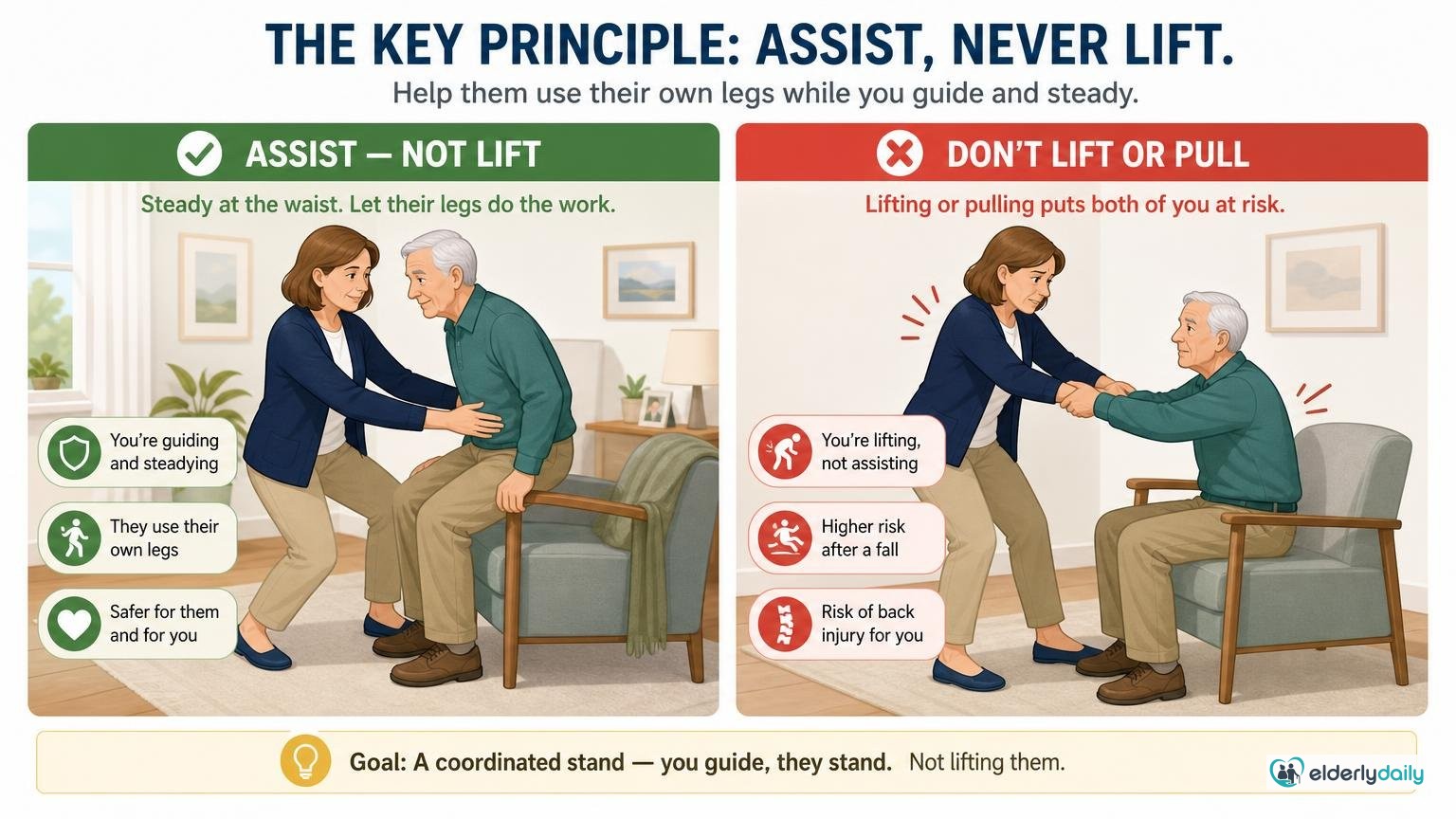
The most important idea in helping someone stand is that you are not lifting them — you are helping them use their own legs while you guide and steady. This protects the person (dead-weight lifting causes falls) and protects you (lifting an adult is how caregivers wreck their backs). A good stand is a coordinated movement powered mainly by the person’s legs, with you providing balance and a little assistance.
This guide covers helping someone stand from a seat or bed, and — separately and importantly — the different, more cautious process of helping someone up after a fall. The two are not the same: after a fall, rushing to lift can cause harm, so that section has its own rules.

Sponsored Pick
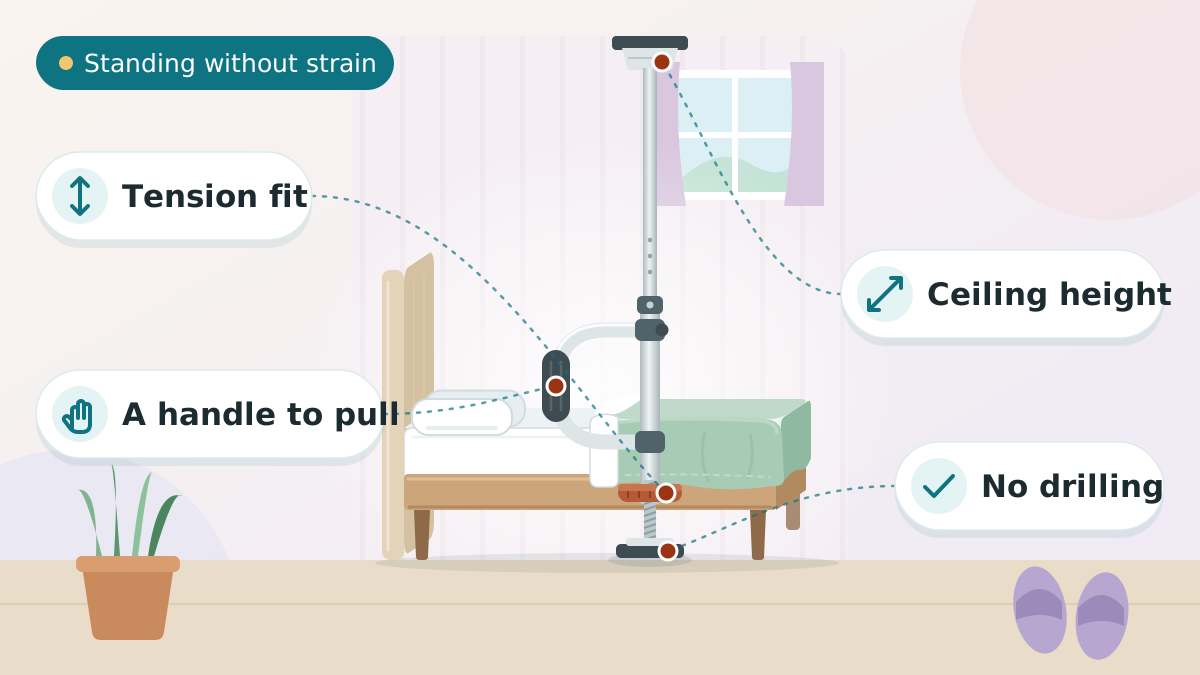
Stander Wonder Pole Plus with Rotating Double Grab Bar
Renters, anyone who cannot drill, or spots with no convenient wall
Check PriceHelping someone stand from a chair or bed
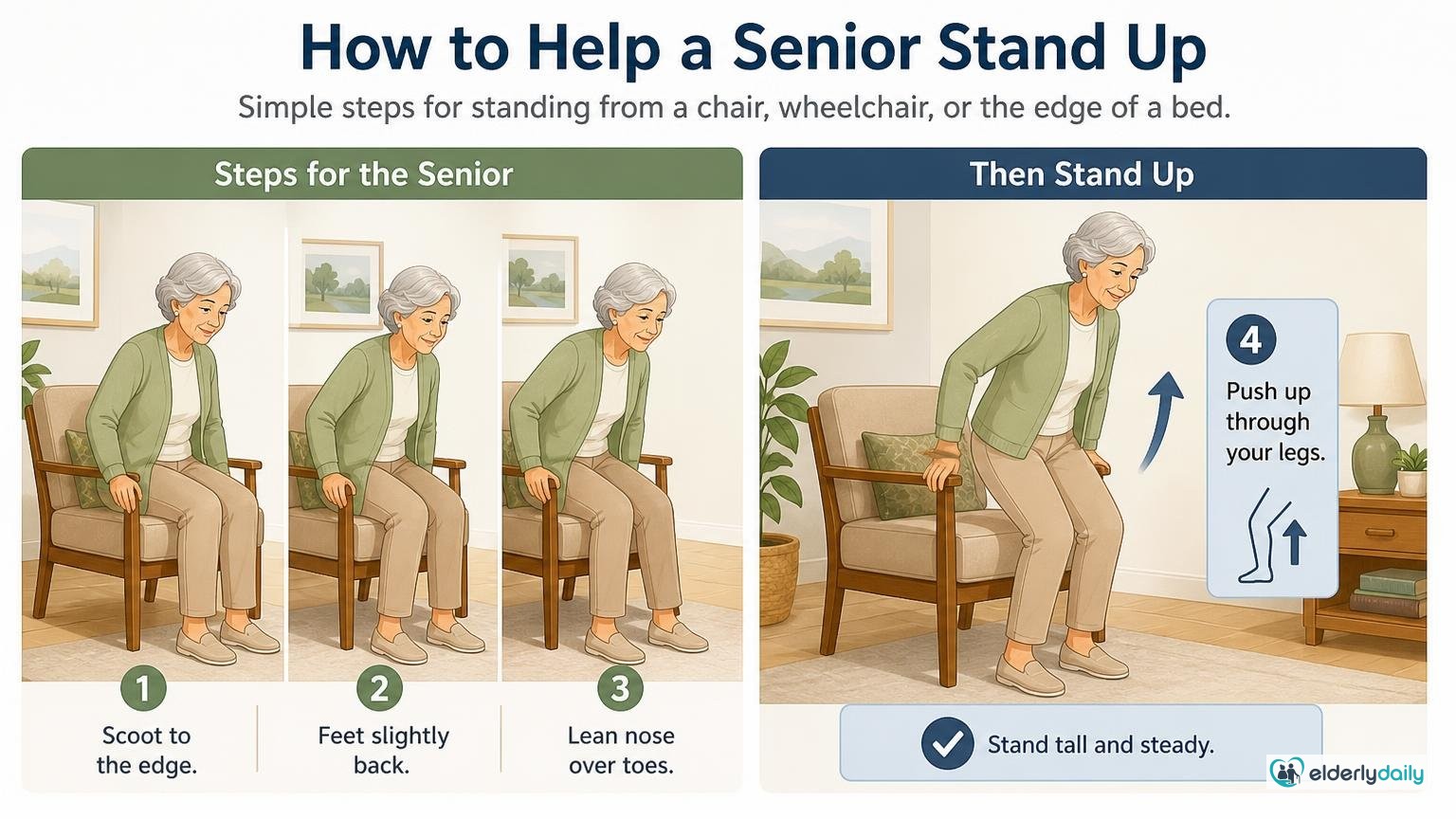
For a routine stand from a chair, wheelchair, or the edge of a bed, follow these steps:
- 1
Prepare
Make sure they are wearing non-slip footwear, the floor is clear, and any wheels (wheelchair, bed) are locked. Stand in front of or beside them, and agree what you are about to do.
- 2
Scoot to the edge
Help them shuffle forward to the front edge of the seat, so their weight is over their feet, not back in the chair.
- 3
Position the feet
Place their feet flat on the floor, about hip-width apart, and slightly back (under or just behind the knees) so they can push up from a strong position.
- 4
Lean forward — nose over toes
Have them lean their upper body forward over their feet. This brings their center of gravity over their legs, which is what makes standing possible — many people fail to stand simply because they lean back.
- 5
Push and rise together
On an agreed signal ("ready, steady, stand"), they push up through their legs using the armrests, a grab bar, or a transfer pole, while you steady them at the waist (a gait belt gives a secure hold). Do not pull on their arms.
- 6
Pause before moving
Once up, let them stand still and get their balance, and check they are not dizzy, before taking any steps.
Good to know
"Nose over toes" is the whole trick. Most standing difficulty comes from leaning back instead of forward. Coach them to bring their nose out over their toes and push through their heels, and standing becomes far easier.
Protecting your own back
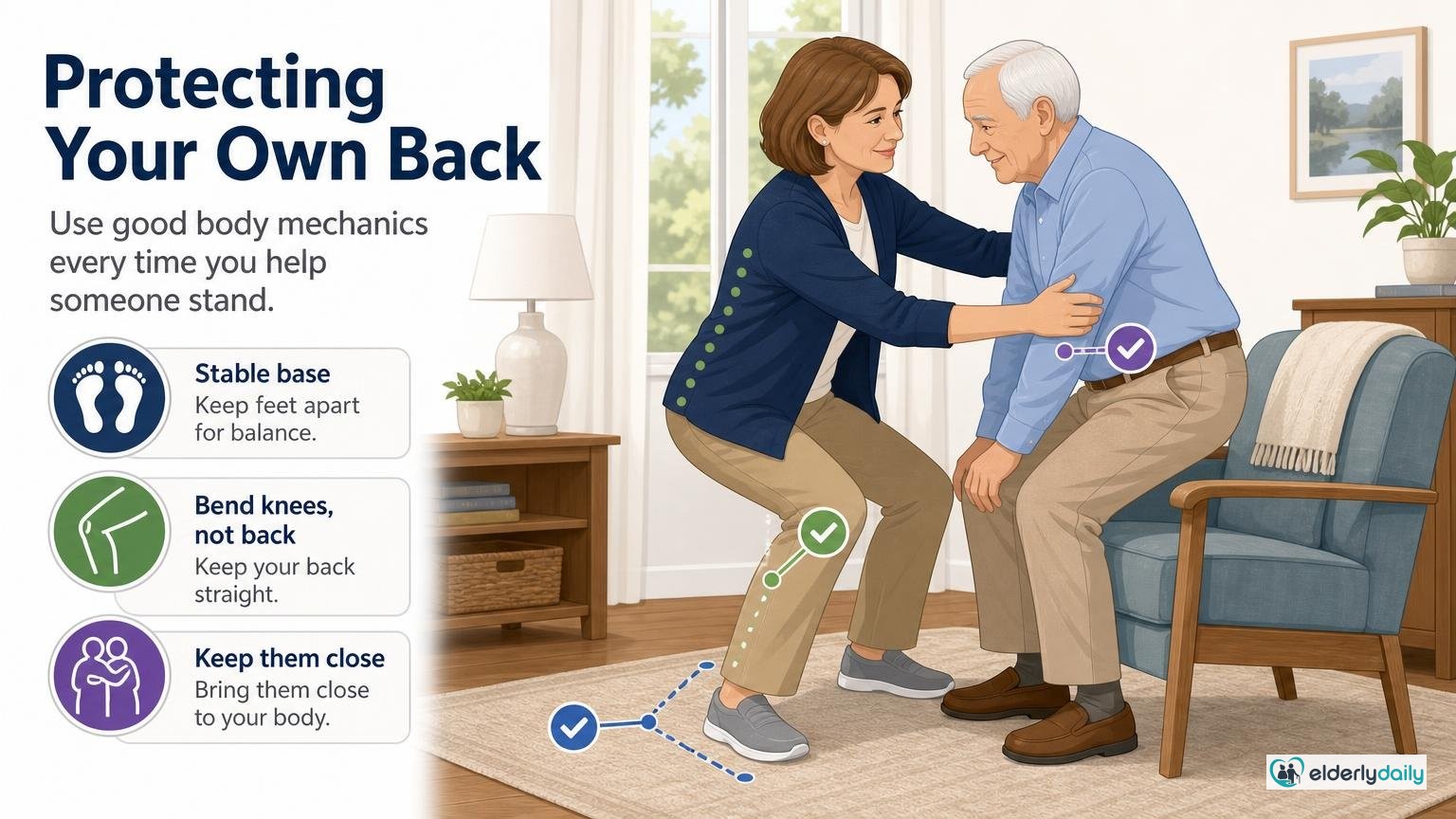
Helping someone stand is a leading cause of caregiver back injury, so your own body mechanics matter every time:
- Stable base — stand close with feet shoulder-width apart, one foot slightly forward.
- Bend knees, not back — keep your back straight and bend at your knees and hips.
- Keep them close — the further the weight is from your body, the more strain; hold them near you.
- Never twist — turn by stepping with your feet, not by rotating your spine under load.
- Never pull on their arms or under the armpits — support at the waist instead, and let their legs power the stand.
- Use a gait belt for a secure, safe hold whenever you are assisting a weak person.
The full range of related moves is in safe transfer techniques.
Helping someone up AFTER a fall — assess first
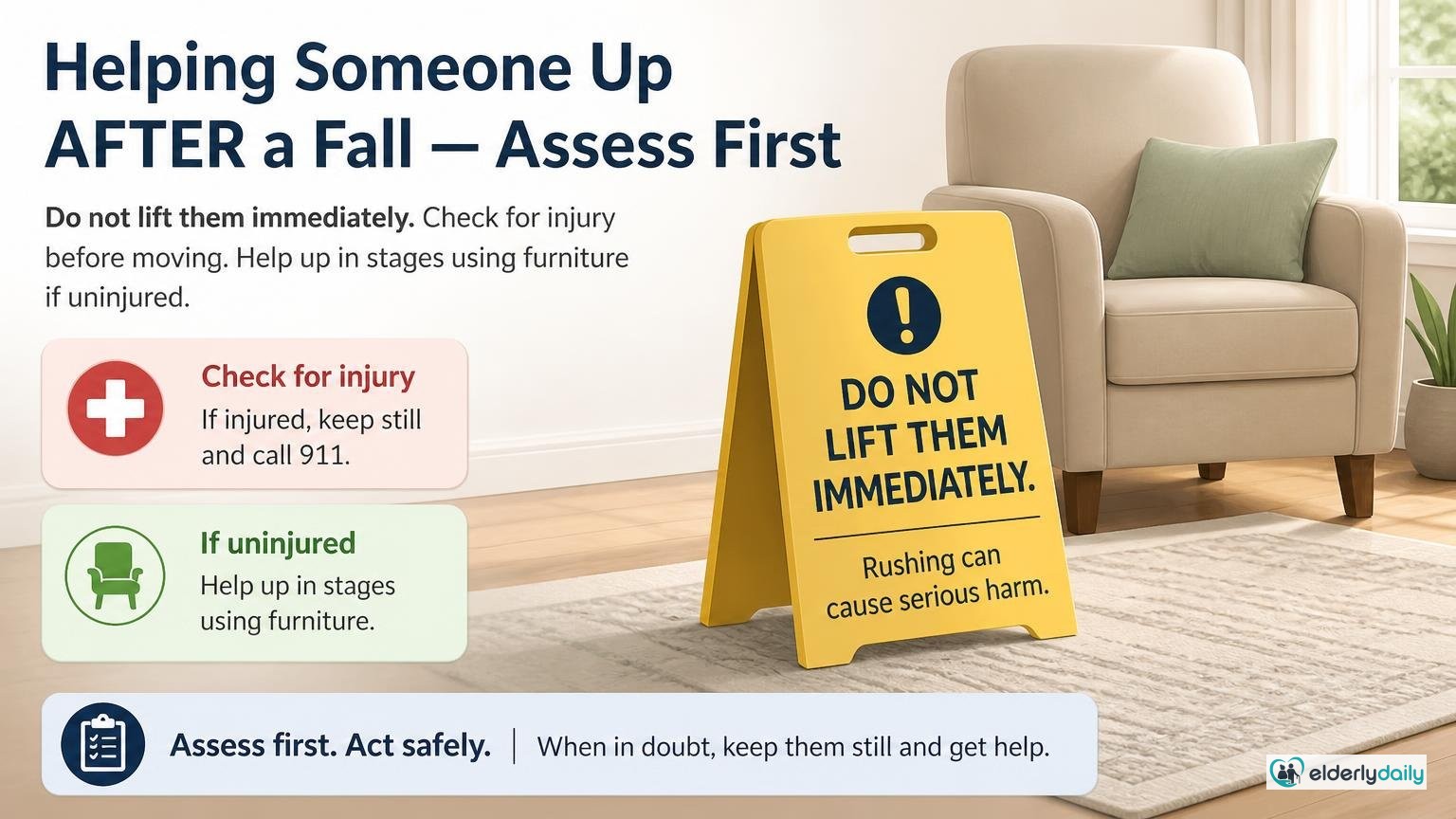
This is different and requires caution. When someone has fallen, the instinct is to get them up quickly — but rushing can cause serious harm. Do not lift them immediately. Instead:
- 1
Stay calm and check for injury
Before any attempt to move, check whether they are hurt. Ask about pain (especially hip, back, head, or neck), look for obvious injury or deformity, and ask if they hit their head. Do NOT move them if you suspect a serious injury.
- 2
If injured or unable to move — call for help
If there is a possible fracture (severe pain, a leg turned oddly), a head or neck injury, they are on blood thinners and hit their head, they cannot get up, or they are confused or unwell — keep them still, comfortable, and warm, and call emergency services. See why dad is falling more often for fall red flags.
- 3
If they seem uninjured, let them rest first
Give them a few minutes to recover from the shock before attempting to get up — rushing invites another fall.
- 4
Get up in stages, using furniture
If uninjured and able, guide them to roll onto their side, push up to hands and knees, crawl to a sturdy chair, place their hands on the seat, bring one foot flat (into a kneeling-lunge), and push up to turn and sit — while you steady, not lift. Let them do the work in stages.
- 5
If they cannot get up but seem uninjured
Do not struggle to lift them. Keep them comfortable and warm on the floor and call for help (non-emergency line or emergency services as appropriate). A medical alert device is invaluable for exactly this.
Safety first
After a fall, never lift someone before checking for injury. If you suspect a fracture, head or neck injury, or they are on blood thinners and hit their head — do not move them; keep them still and call emergency services. Getting up too fast, or being lifted with an injury, can cause serious harm.
When to get help or equipment
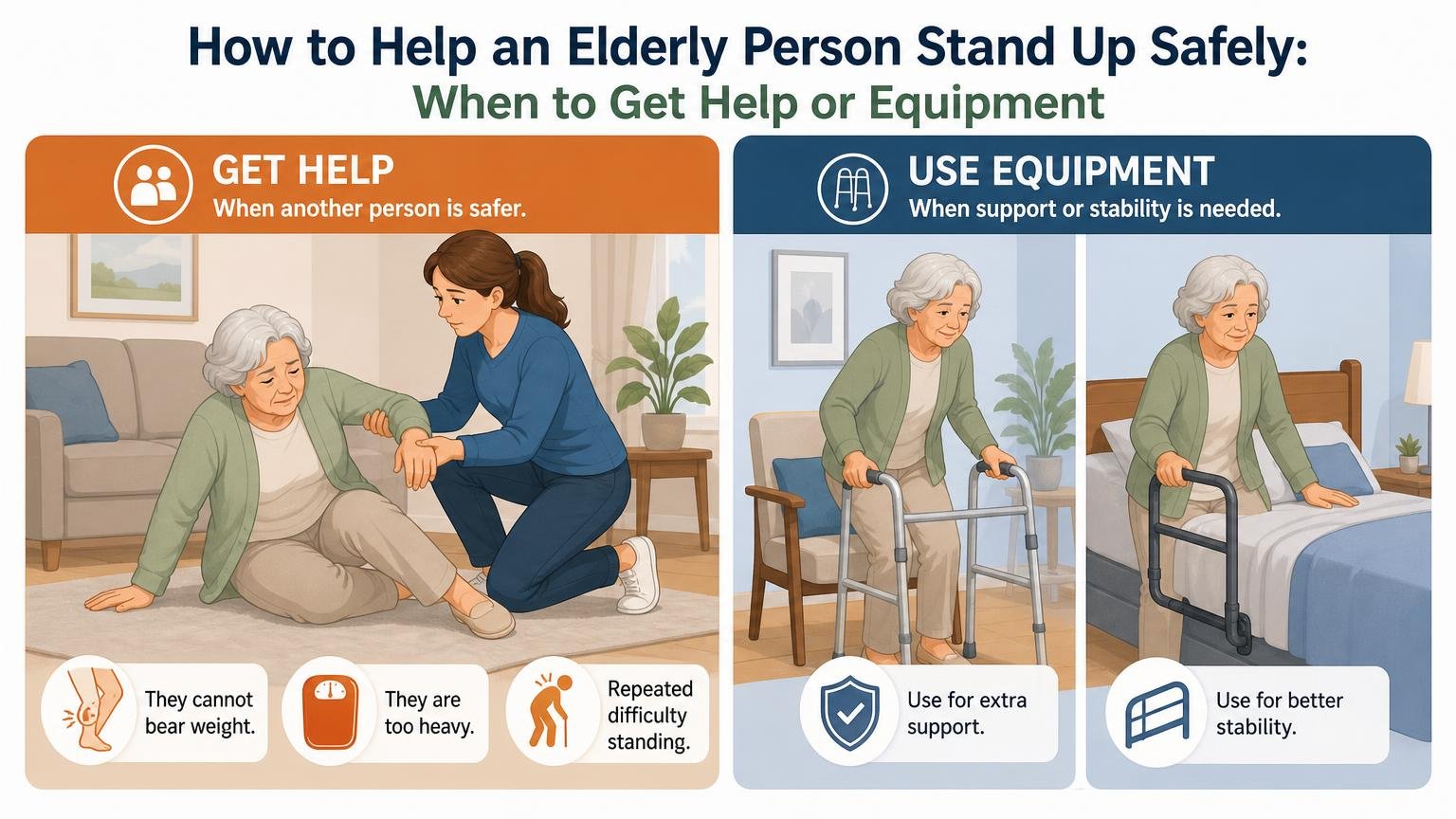
Know the situations where assisting alone is unsafe:
- They cannot bear weight on their legs — do not try to haul them up; you need equipment or trained help.
- They are too heavy for you to steady safely — get a second person.
- Repeated difficulty standing points to a need for a proper assessment — physical therapy, the right equipment, and addressing the underlying weakness.
- If the difficulty is specifically standing from a chair, and it happens several times a day, a powered lift chair does the lifting instead of you. That matters for your back as much as for them — the technique above is sound, but doing it eight times a day is how caregivers get injured.
- If the hard part is getting out of BED rather than a chair, the equivalent options run from a transfer pole or bed assist handle up to a rotating transfer bed at the far more expensive end. Work up from the cheap end — it solves the problem for most people, and the costly end is not right for someone who cannot take their own weight at all.
- Frequent falls — investigate the cause and prevent them; see why an elderly parent keeps falling and set up home safety.
- Get trained — a physical or occupational therapist can teach safe technique for your specific situation, which is safer than any written guide.
Frequently asked questions
How do I help an elderly person stand up from a chair?
Help them scoot to the front edge of the seat, place their feet flat and slightly back about hip-width apart, have them lean forward "nose over toes" to bring their weight over their legs, then on a signal they push up through their legs using the armrests or a grab bar while you steady them at the waist. Let them stand still and get their balance before moving. Never pull them up by the arms.
How do I help someone up after a fall?
Do not rush to lift them. First check for injury — ask about pain (hip, back, head, neck), look for obvious injury, and ask if they hit their head. If injury is suspected, or they cannot get up, keep them still and warm and call for help. If uninjured, let them rest, then guide them to roll to their side, get to hands and knees, crawl to a sturdy chair, and push up in stages while you steady them.
Why should I not lift an elderly person by their arms?
Pulling on the arms or under the armpits can injure their vulnerable shoulders and unbalances both of you, risking a fall. It also puts you at risk of a back injury. Instead, support at the waist (ideally with a gait belt) and let the person push up through their own legs using armrests, a grab bar, or a transfer pole.
What should I do if my parent falls and cannot get up?
Stay calm and check for injury first. If they seem hurt (possible fracture, head or neck injury, on blood thinners and hit their head, confused or unwell), keep them still, comfortable, and warm and call emergency services — do not move them. If uninjured but simply unable to get up, do not struggle to lift them; keep them comfortable on the floor and call for help. A medical alert device is invaluable here.
How do I protect my back when helping someone stand?
Stand close with a stable base (feet apart, one slightly forward), bend your knees and hips rather than your back, keep your back straight and the person close to your body, never twist under load (turn with your feet), and never pull on their arms. Let their legs power the stand while you steady them at the waist, ideally with a gait belt, and get help for anyone you cannot assist safely.
When should I get help instead of helping them stand myself?
Get help or equipment if the person cannot bear weight on their legs, is too heavy for you to steady safely, is injured, or if you have not been shown safe technique. Repeated difficulty standing or frequent falls means the underlying weakness and fall risk need proper assessment — physical therapy and the right equipment — rather than repeatedly improvising.
