
The Clock Drawing Test for Dementia


Medically reviewed by Dr. Shifin Shad PN, MBBS, BCCPM · Reviewed 26 July 2026
Educational guidance, not medical advice or a diagnostic tool. A concerning result should be discussed with a qualified clinician, who can rule out treatable causes and arrange proper assessment.
Draw a clock, add the numbers, set the hands to a time. It sounds trivially simple, but it quietly tests memory, planning, and spatial thinking at once — which is why clinicians use it. Here is what it can show, how it is scored, and, most importantly, what a poor clock does and does not mean.
Key takeaways
- In the clock drawing test, a person draws a clock face, fills in all the numbers, and sets the hands to a specific time (often "ten past eleven"). It quietly checks memory, planning, and visuospatial skill at once.
- It is a screening tool, not a diagnosis. A poor clock is a *signal to seek a full evaluation* — never, on its own, a diagnosis of dementia.
- Revealing errors include numbers crowded or pushed to one side, missing or repeated numbers, and hands set to the wrong time — patterns that point to planning and spatial difficulties.
- It is often paired with a three-word memory recall as the Mini-Cog (about three minutes); the clock alone is less sensitive and is usually used *alongside* other tests.
- Many things besides dementia affect it — delirium, stroke, depression, poor vision, and limited education or language.
- After a concerning clock, the next step is a doctor visit to rule out treatable causes and, if needed, arrange fuller cognitive assessment.
Quick answer
What is the clock drawing test, and can it diagnose dementia?
The clock drawing test is a quick pen-and-paper screen in which a person draws a clock, adds all the numbers, and sets the hands to a stated time. Because it needs memory, planning, and spatial skill together, a clearly wrong clock can flag possible cognitive impairment. But it cannot diagnose dementia on its own — the Mini-Cog, which pairs it with a three-word recall, is explicitly not a diagnostic test. A concerning clock means *see a clinician for a proper evaluation*, not that a person has dementia. Many other things — delirium, stroke, depression, vision, and education — also affect the drawing.
What the clock drawing test is
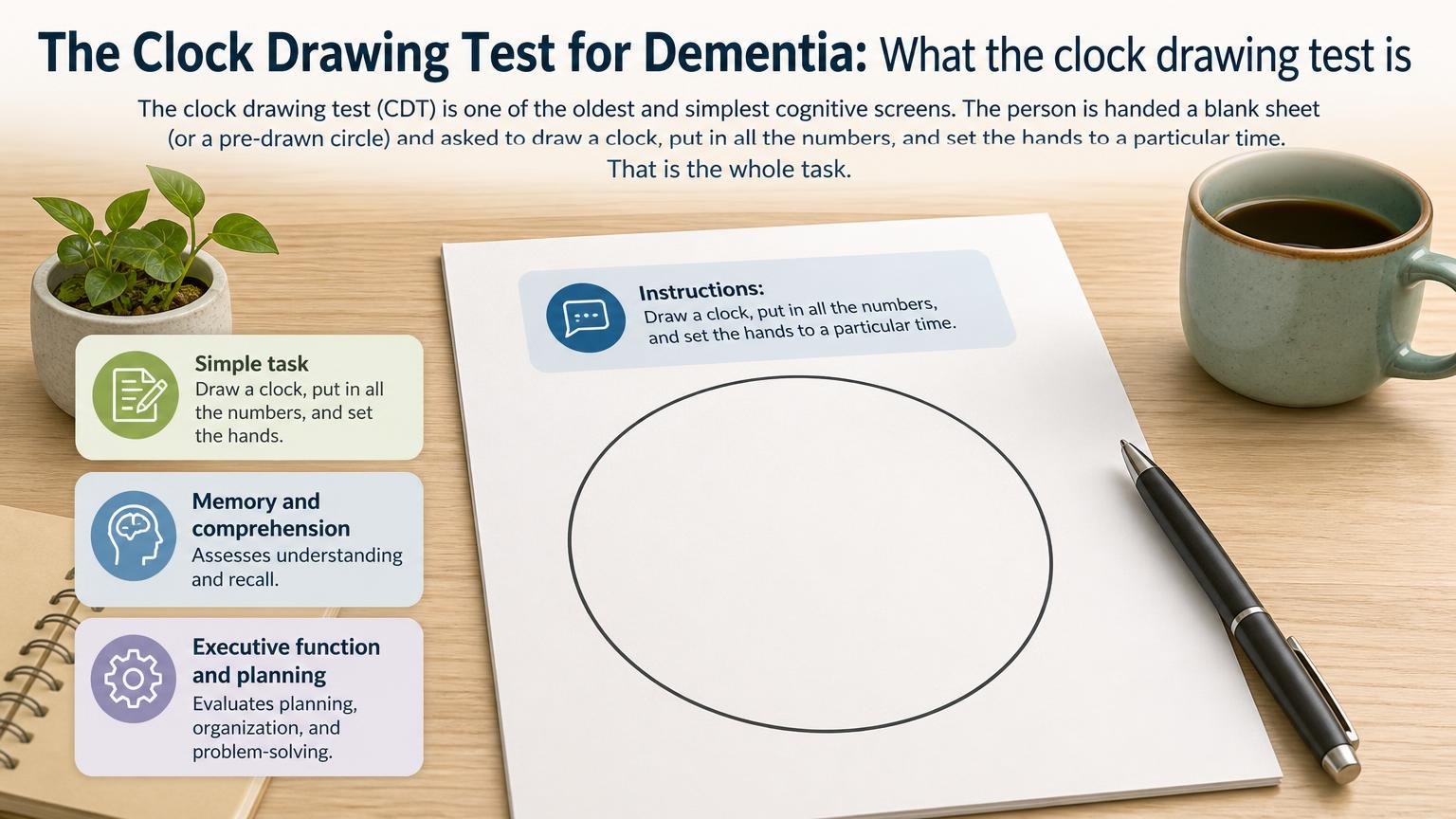
The clock drawing test (CDT) is one of the oldest and simplest cognitive screens. The person is handed a blank sheet (or a pre-drawn circle) and asked to draw a clock, put in all the numbers, and set the hands to a particular time. That is the whole task.
Its usefulness comes from how much it asks the brain to do at once. Drawing a correct clock quietly draws on several abilities together:
- Memory and comprehension — holding the instructions in mind and remembering what a clock looks like.
- Executive function and planning — organising the numbers evenly around the face and placing the hands correctly.
- Visuospatial skill — arranging everything in the right place in space.
Because a problem in any of these areas can distort the drawing, the CDT is used to help flag possible cognitive impairment and to monitor change over time. It is not specific to Alzheimer’s disease — a distorted clock can also appear with other dementias, delirium, or stroke.
An ElderlyDaily original
Want the whole thing in one place?
Dementia Caregiver Command Center
- Daily care and medication logs in one place
- Behaviour-pattern tracking, to spot what makes a day harder
- Safety pages and caregiver handoff sheets for family and respite helpers
One-off purchase. Instant download.
Fillable PDF · US Letter + A4

Sponsored Pick
Tracki Mini GPS Tracker
Early-to-mid dementia, where the person will carry something but refuses to wear a device
Check PriceHow the test is done
In a clinic the administration is brief and standardised. Knowing the steps helps you understand what a result is based on:
- 1
Draw the clock face
The person is asked to draw a round clock. Some versions provide a pre-printed circle so the score focuses on the numbers and hands rather than the circle itself.
- 2
Add all the numbers
They fill in the numbers 1 to 12, in the right places around the face. How evenly and correctly the numbers are spaced is a big part of what the test reveals.
- 3
Set the hands to a stated time
They are asked to draw the hands to show a specific time — commonly "ten past eleven" (11:10), which is chosen because it requires processing both numbers and resists simply pointing the hands at the numbers named.
- 4
The clinician reviews the drawing
The finished clock is scored using one of several systems (below), and — importantly — interpreted in the context of the person’s history, other tests, vision, and education.
Good to know
It is often combined with a short memory task. In the widely used Mini-Cog, the person first hears three words to remember, then draws the clock, then recalls the three words. The whole thing takes about three minutes.
What the drawing can reveal
A clinician looks less at neatness and more at the *kind* of error. Different mistakes point to different difficulties:
- Numbers crowded together or pushed to one side — often reflects planning and visuospatial difficulty; numbers all on one side can also signal spatial neglect after a stroke.
- Missing, extra, or repeated numbers — repeating numbers or losing track can reflect reduced cognitive flexibility, sometimes seen in Alzheimer’s.
- Hands set to the wrong time, or more than two hands — trouble translating "ten past eleven" into hand positions is a common and telling executive-function error.
- A generally disorganised or incomplete clock — can appear even in earlier stages when planning is affected.
These patterns are clues, not verdicts. A single unusual clock from someone who is tired, anxious, or has poor eyesight is very different from a clearly disorganised clock that fits with other changes a family has noticed.
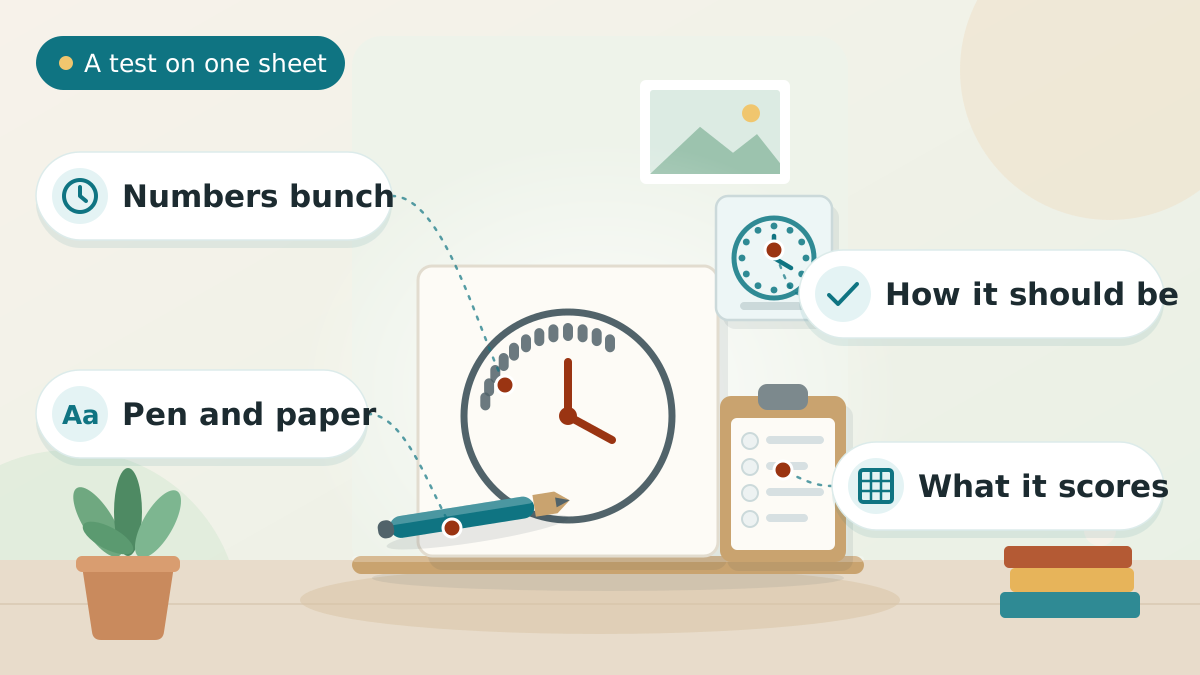
| What the clock looks like | What it may reflect |
|---|---|
| Numbers bunched up or all on one side | Planning / visuospatial difficulty (or neglect after stroke) |
| Numbers missing, repeated, or out of order | Reduced cognitive flexibility |
| Hands set to the wrong time | Executive-function difficulty (translating the instruction) |
| Clock left incomplete or disorganised | Broad planning or comprehension difficulty |
How it is scored (and why not to score it at home)
There is no single official score. Researchers count more than twenty different scoring systems for the clock drawing test, which is one reason it is used alongside other measures rather than alone. Two of the most common:
- The Mini-Cog approach — the clock is scored simply as normal (2 points) or abnormal (0), then added to the three-word recall (0–3) for a total out of 5. On the published Mini-Cog scoring, a total of 0–2 suggests a higher likelihood of clinically important impairment and warrants further evaluation.
- The Shulman method — the clock is rated on a 0–5 scale, with more and more significant errors producing a lower score.
The scoring looks deceptively easy, which is exactly why it is worth being careful. Interpreting a clock properly means weighing the *type* of error against the person’s vision, education, language, mood, and medical history — and comparing it with other tests. A worried family member scoring a clock at the kitchen table can easily read too much into a shaky drawing, or be falsely reassured by a "good enough" one.
Watch out
Treat any at-home clock as a conversation starter, not a result. It is fine to notice that a parent struggled with it — that is a good reason to book a check-up. It is not fine to conclude from it that they do, or do not, have dementia.
What a poor result means — and what it doesn’t
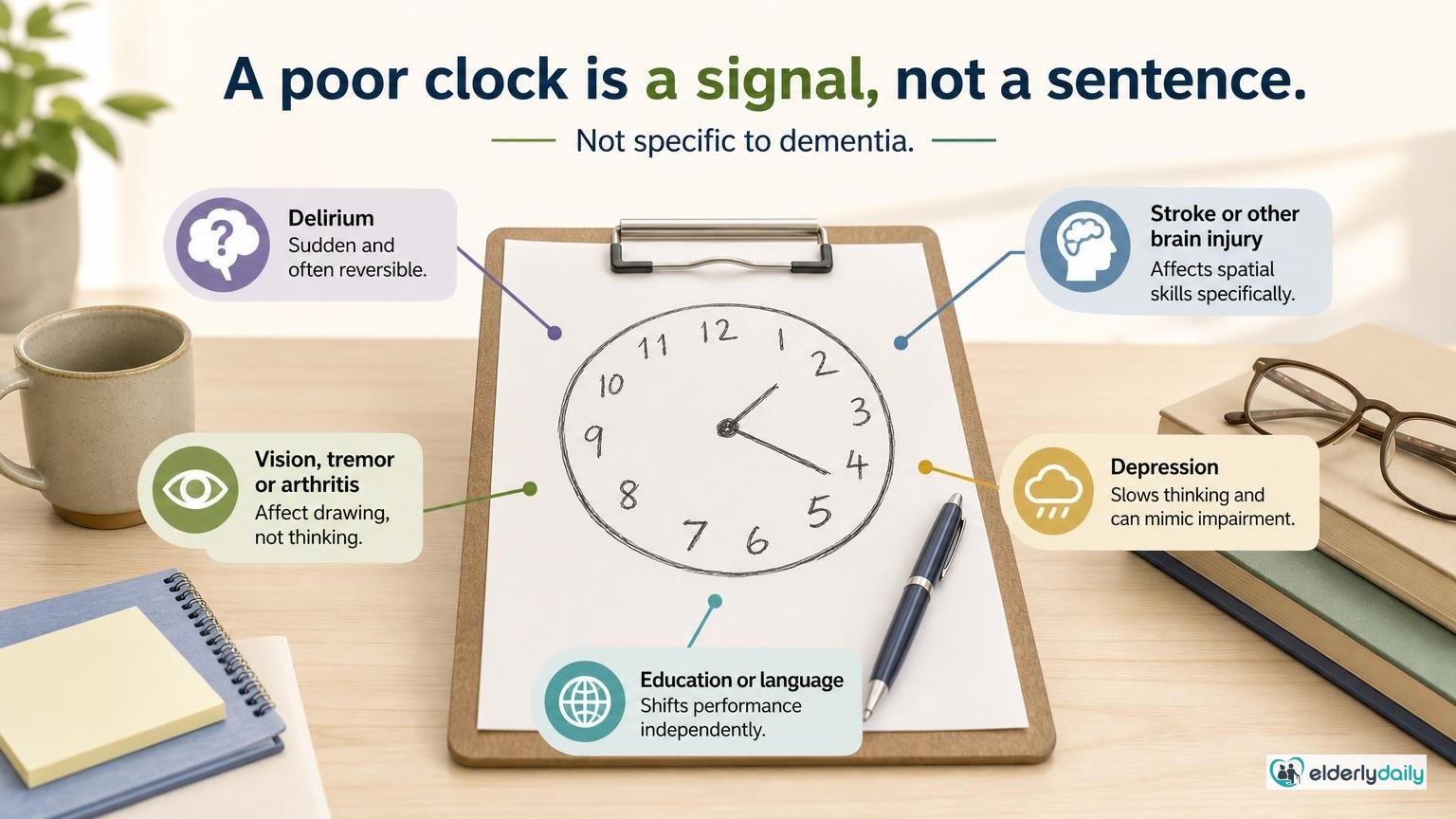
This is the part that matters most. A poor clock is a signal, not a sentence. It suggests that something is affecting thinking and is worth investigating — nothing more and nothing less.
Crucially, a distorted clock is not specific to dementia. Several other things commonly affect it, and several are treatable:
- Delirium — a sudden, often reversible confusion from infection, medication, dehydration, or pain, which can wreck a clock temporarily.
- Stroke or other brain injury — which can affect spatial skills specifically.
- Depression — which can slow thinking and mimic cognitive impairment.
- Poor vision, tremor, or arthritis — which affect the drawing itself, not the thinking behind it.
- Limited education, or English as a second language — which can affect performance independent of any impairment.
And a *normal* clock does not rule everything out either — the test is a relatively blunt instrument, and some people with early changes still draw a passable clock. That is exactly why clinicians pair it with other tools and, above all, do not diagnose from it alone.
What to do after a concerning clock
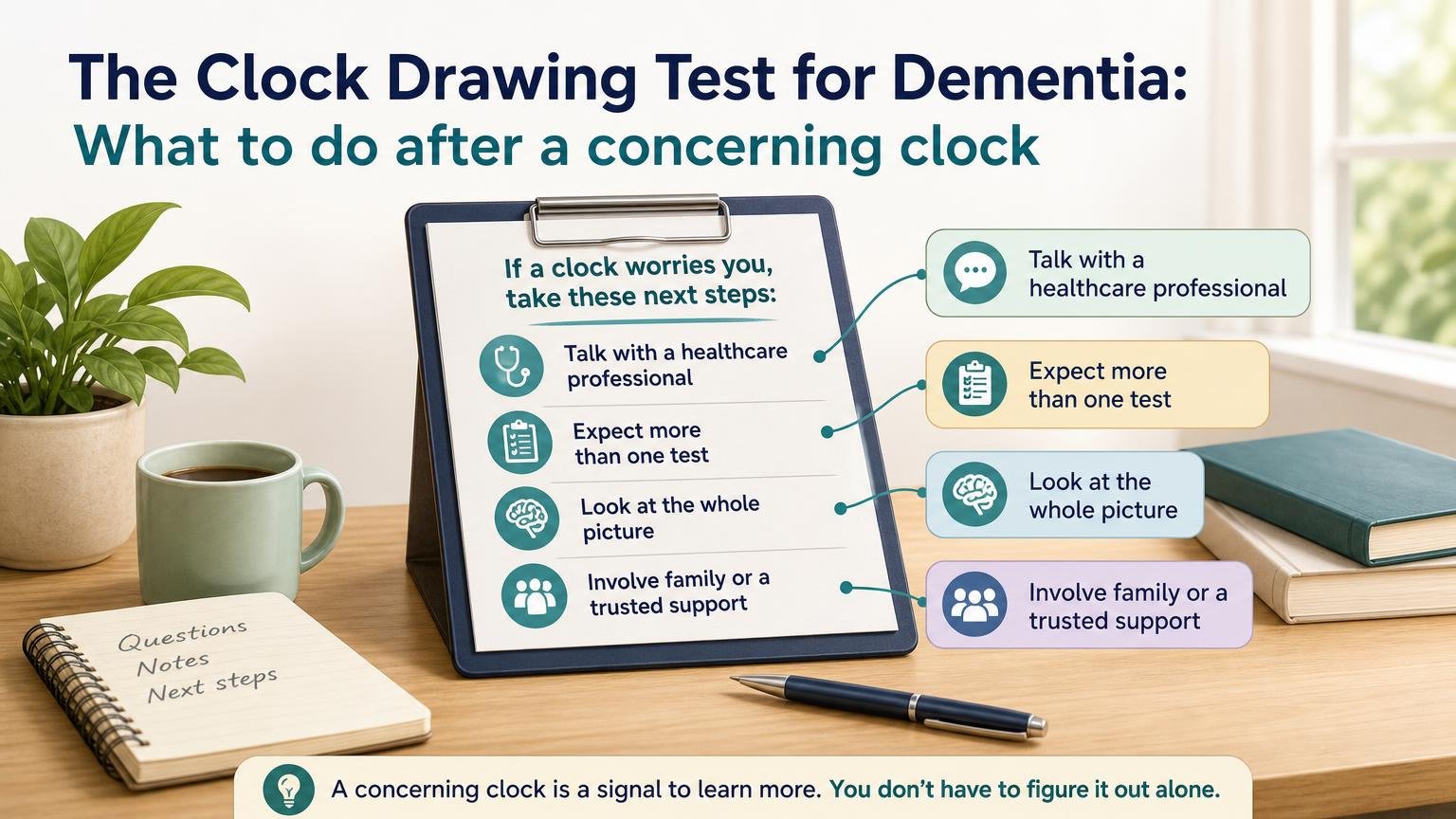
If a clock — whether drawn in a clinic or informally at home — worries you, the path forward is straightforward:
- See the doctor, and mention when the changes started. A gradual change over months and a sudden change over days point in very different directions — the sudden one is often a treatable problem, not dementia.
- Ask them to rule out reversible causes first — infection, thyroid issues, vitamin deficiency, medication effects, depression, and poor sleep can all affect thinking.
- Expect more than one test. A proper evaluation combines history, a fuller cognitive assessment, a physical exam, and sometimes blood work or imaging — the clock is just one small input.
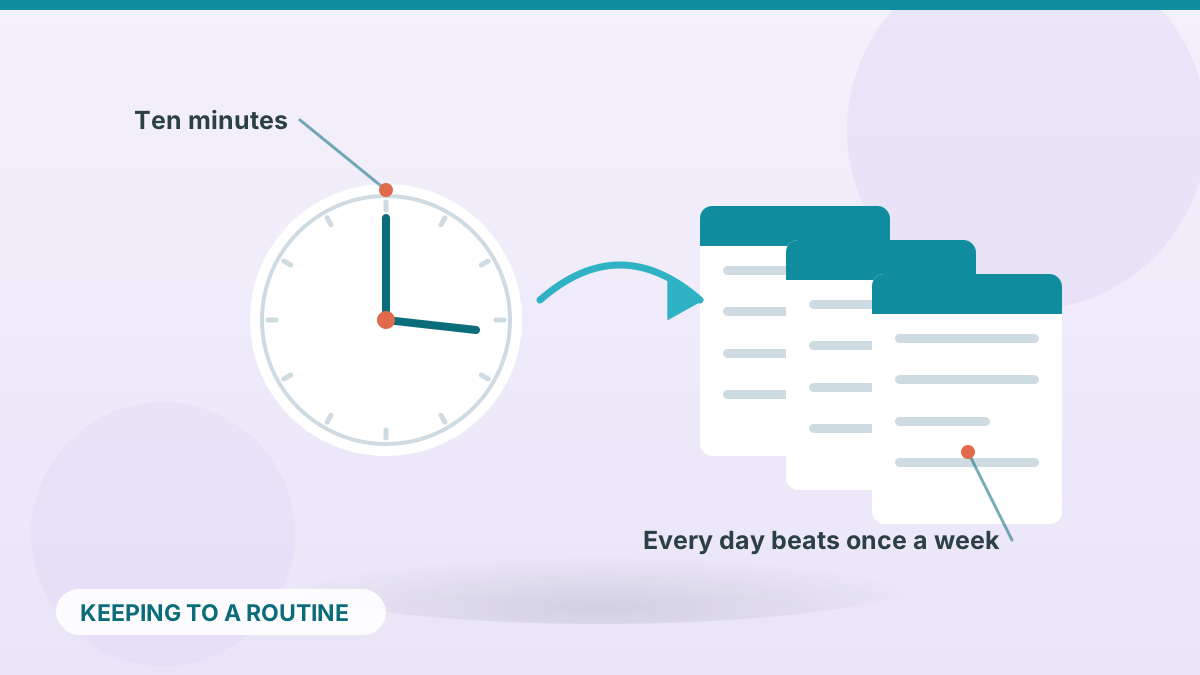
- Focus on support alongside answers. Whatever the cause, practical help makes daily life safer — a clear dementia clock for day-to-day orientation, a predictable daily routine, and reading up on dementia care at home.
The clock drawing test earns its place because it is quick, cheap, and surprisingly informative. But its value is as a *prompt to look further* — the answer always comes from a full assessment by a professional, never from the drawing alone.
Safety first
Seek prompt medical care if confusion, disorientation, or a clear change in thinking comes on suddenly — over hours to a few days — rather than gradually. A sudden change is a medical red flag (often delirium from a treatable cause), not simple progression.
Frequently asked questions
Can the clock drawing test diagnose dementia on its own?
No. It is a screening tool, not a diagnostic test. Even the Mini-Cog, which pairs the clock with a memory task, is explicitly not diagnostic. A concerning clock means a person should have a full evaluation by a clinician, who considers history, other cognitive tests, physical health, and sometimes blood work or imaging before any diagnosis.
What time are you usually asked to draw?
Most versions ask for "ten past eleven" (11:10). That time is chosen deliberately: it forces the person to process both the 11 and the 10, and it resists the shortcut of simply pointing the hands at the numbers that were said aloud. Some clinicians use other times, but the principle is the same.
What does a poor clock drawing actually mean?
It means something is affecting thinking and is worth looking into — not that the person has dementia. Distorted clocks also appear with delirium (often reversible), stroke, depression, poor vision, tremor, and limited education or language. It is a signal to seek evaluation and to rule out treatable causes, not an answer in itself.
How is the clock drawing test scored?
There are over twenty scoring systems. Two common ones: the Mini-Cog scores the clock as normal (2) or abnormal (0) and adds a three-word recall for a total out of 5, where 0–2 suggests higher likelihood of impairment; the Shulman method rates the clock 0–5 by the number and severity of errors. Because scoring is not standardised, the test is used alongside other measures.
Can I do the clock drawing test at home?
You can certainly ask a parent to draw a clock, and noticing that they struggle is a good reason to book a check-up. But treat it only as a conversation starter, not a result — it is easy to over-read a shaky drawing or be falsely reassured by a rough one. Leave the scoring and interpretation to a clinician, who weighs it against vision, mood, education, and other tests.
What besides dementia can affect the test?
Quite a lot. Delirium from infection, medication, dehydration or pain; stroke (especially spatial neglect); depression; poor eyesight, tremor, or arthritis affecting the drawing itself; and limited education or a non-native language. Several of these are treatable, which is why a full medical work-up — not the clock alone — is what matters.
Sources
- National Institute on Aging (NIH). Cognitive Health and Older Adults
- National Institute on Aging (NIH). The Dilemma of Delirium in Older Patients
