
UTI Signs in Seniors: The Symptoms Families Miss


Medically reviewed by Dr. Shifin Shad PN, MBBS, BCCPM · Reviewed 29 July 2026
Educational guidance, not medical advice. A suspected UTI in an older adult should be assessed and tested by a doctor; a UTI with severe illness is a medical emergency.
In older adults, the more typical signs of a urinary tract infection — new or worsening urinary symptoms, or other signs of infection — can be less obvious in frail seniors. Sudden confusion or "not being themselves" can occur alongside a UTI, but it's nonspecific and has many other causes — it should prompt medical assessment, not be taken as proof of a UTI by itself.
Key takeaways
- In seniors, watch for new or worsening urinary symptoms (burning, urgency, or frequency) and other signs of infection — these can be less obvious in frail older adults. New onset confusion, agitation, lethargy, sudden incontinence, or eating and drinking less can occur alongside a UTI, but these are nonspecific and have many other causes — they should prompt a medical check, not be assumed to mean UTI.
- Sudden new confusion can occur alongside a UTI in an older adult, but it’s nonspecific — it needs medical assessment to find the actual cause, not an assumption that it’s a UTI.
- New incontinence, weakness, or increased sleepiness can come alongside a UTI, but they have many causes — a sudden change in any of these needs a prompt medical check to find the cause.
- Untreated, a UTI can progress to a kidney infection or sepsis, which is dangerous — watch for fever with or without shivering, lower back or flank pain, and urinary urgency, frequency or discoloured urine.
- The response is a prompt medical assessment — a urine test may be part of it, but a positive result alone does not confirm a UTI in an older adult, and treatment usually resolves the symptoms when infection is the cause.
- A positive urine test alone does not prove the confusion is from a UTI — bacteria in the urine is common in older adults who are not ill. Ask the doctor to find the cause rather than asking for antibiotics — unless there are urinary symptoms, fever or signs of sepsis, which need urgent treatment.
Quick answer
What are the signs of a UTI in an elderly person?
The more typical signs of a UTI — new or worsening burning, urgency, or frequency, along with other signs of infection — can be less obvious in frail older adults. Sudden confusion, agitation, falls, new incontinence, weakness, or drowsiness can occur alongside a UTI, but these are nonspecific and have many other possible causes. Because they’re easy to blame on aging or dementia, any sudden change in behavior or function should prompt medical assessment rather than being taken as evidence of a UTI by itself. High-grade fever, back or side pain, or decreased responsiveness or drowsiness can indicate a more serious infection and needs urgent care. The response is prompt urine testing and treatment.

Why UTIs look different in older adults
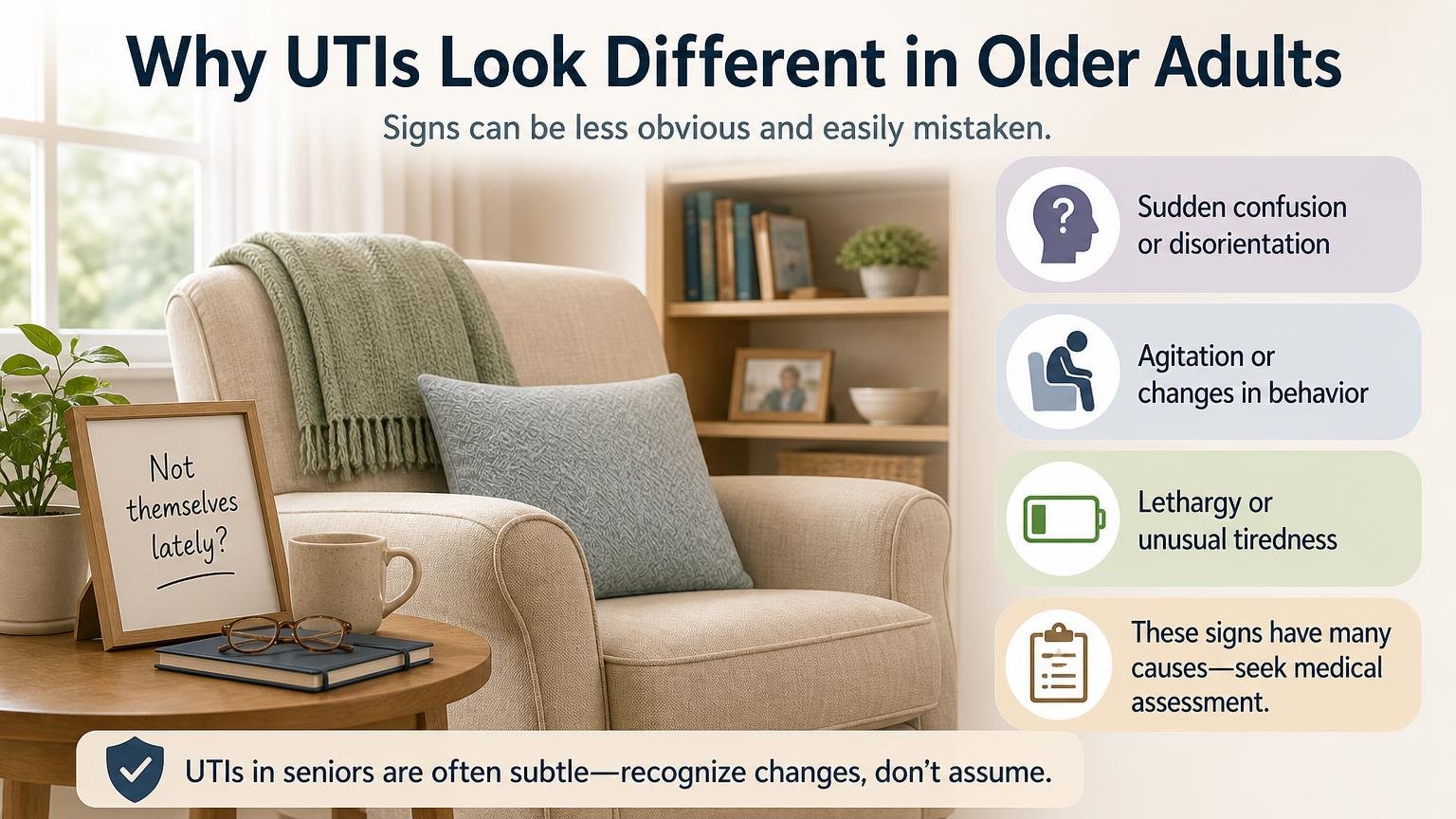
In younger adults, a urinary tract infection announces itself: burning when urinating, urgency, frequency, and lower-abdominal discomfort. In older adults — especially the frail or those with dementia — these same signs can be less obvious. Sudden confusion, agitation, lethargy, or simply "not being themselves" can occur alongside a UTI, but these are nonspecific and have many other causes — they should prompt medical assessment, not be assumed to mean a UTI.
This is why UTIs in seniors are so frequently missed or mistaken for something else — dementia progression, "just a bad day," or aging. And catching them matters, because a UTI is easily treated when found, but can become dangerous if left. The single most useful mindset is: when an older person changes suddenly, it’s worth a medical check — a UTI is one possible cause among several.
The signs families miss
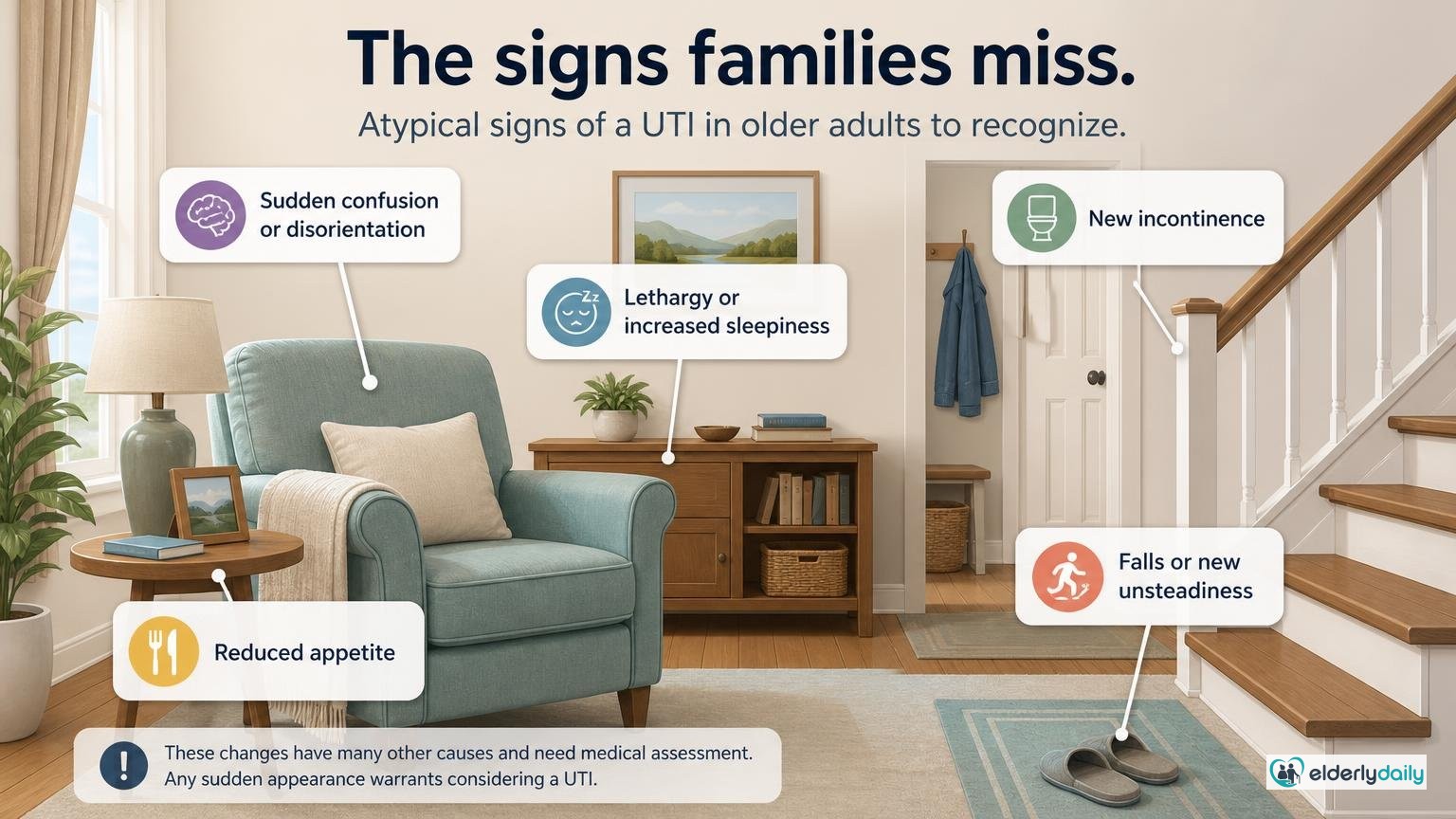
These are the atypical presentations to recognize — any sudden appearance of them warrants considering a UTI:
- Sudden confusion or disorientation — can occur alongside a UTI, but it’s nonspecific and has many other causes; see why mom is confused at night. In someone with dementia, a sudden worsening is worth a prompt medical check.
- Agitation, restlessness, or behavior change — new irritability or distress.
- Falls or new unsteadiness — not a direct effect of the infection, but they can follow from the confusion and drowsiness that come with it; see why dad is falling more often.
- New incontinence or a change in urination — see elderly suddenly incontinent.
- Increased sleepiness, weakness, or a general decline — see why my parent is sleeping all day and suddenly so weak.
- Reduced appetite or feeling generally unwell — another nonspecific change worth a medical check.
Good to know
The rule of thumb: when an older adult suddenly becomes confused, starts falling, or is not themselves, get it assessed promptly. A UTI is one of the things worth checking — but ask what is causing the change rather than asking only for a urine test, because several other causes look the same.
The more typical urinary symptoms

These can be less obvious in frail older adults, but are still the primary things to watch for:
- Burning or pain when urinating.
- Urgency and frequency — needing to go often or suddenly.
- Blood in the urine always needs medical assessment. (Cloudy or strong-smelling urine alone is nonspecific and isn’t reliable evidence of a UTI on its own.)
- Lower-abdominal or pelvic discomfort.
Whether the signs are classic or atypical, the response is the same: get it assessed and tested.
When a UTI is an emergency
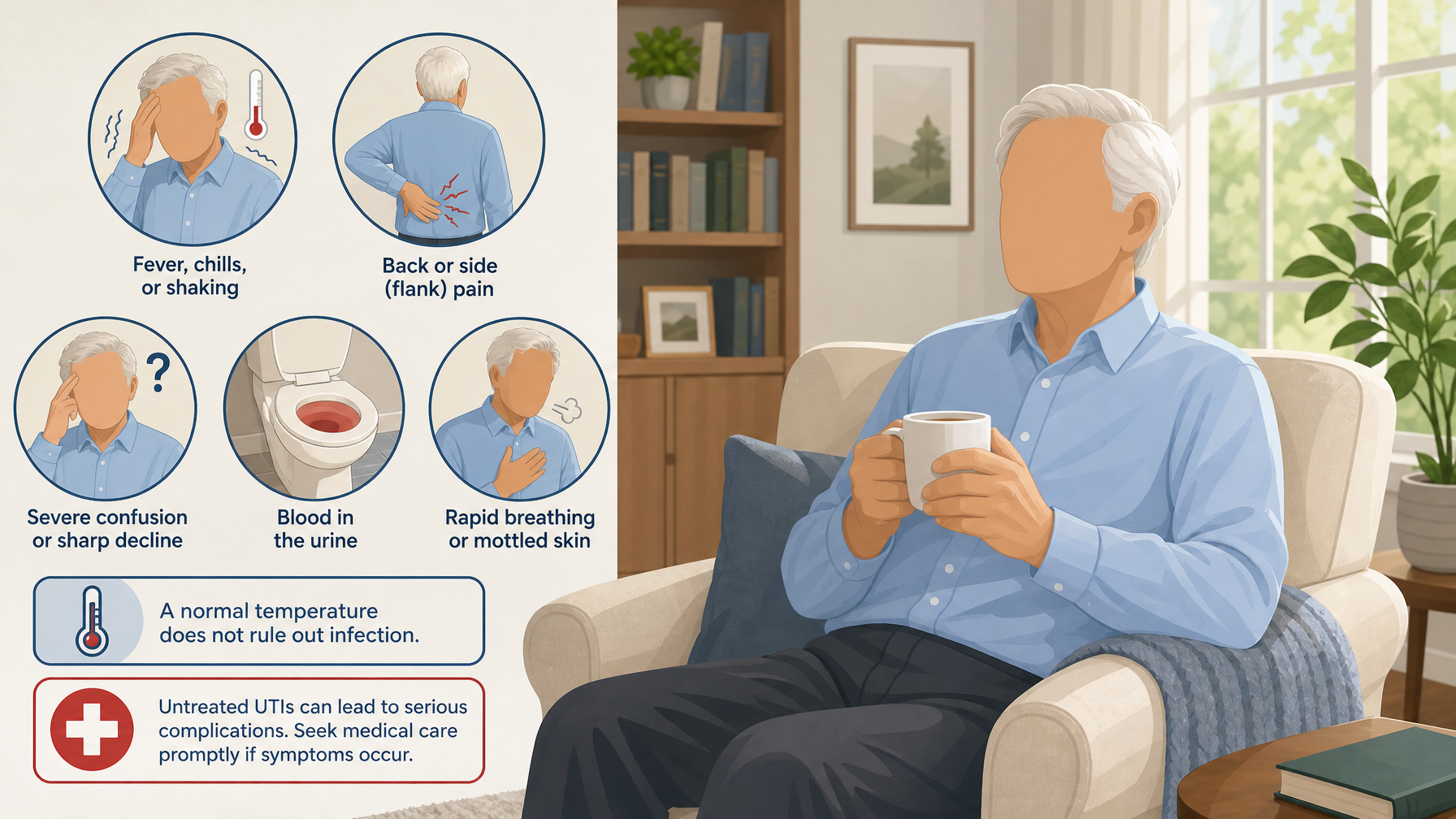
Most UTIs are straightforward, but an untreated infection can spread to the kidneys or bloodstream, which is serious in older adults. Seek urgent or emergency care if there is:
- Fever, chills, or shaking, or feeling very unwell.
- Back or side (flank) pain — suggesting a kidney infection.
- Severe confusion, drowsiness, or a sharp decline in cognitive or day-to-day function — possible sepsis, which is a medical emergency.
- Blood in the urine, or an inability to urinate.
- Rapid breathing or heart rate, or clammy, mottled skin — possible signs of serious infection.
Our incontinence warning signs and emergencies guide covers these red flags in more detail.
A normal temperature does not rule out infection
Many older adults never develop a fever even when seriously ill — fever is often absent or blunted in older adults with serious infection — it may be missing in roughly 20–30% (Norman, Clinical Infectious Diseases, 2000), and more often in sepsis, and a low temperature can itself be a warning sign. Judge by the whole person, not the thermometer. New onset confusion, sudden tiredness, not eating or drinking, a fall, or any sudden change from their usual self is a reason to seek urgent care — even if the temperature is normal. A UTI with back pain, severe confusion, or a rapid decline in day-to-day or cognitive function can mean a kidney infection or sepsis — a medical emergency. Seek urgent care immediately rather than waiting.
What a positive urine test does — and does not — prove

This is the part most caregiver guides leave out, and it matters. Bacteria in the urine are common in older adults who are not ill at all — more so the older and frailer the person. Doctors call it asymptomatic bacteriuria: bacteria present, no infection. Treating it with antibiotics does not improve anything, and it carries real harm — side effects, C. difficile infection, and antibiotic resistance.
So a positive urine test in a confused older adult does not, by itself, prove the confusion came from a UTI. It may only mean the bacteria were there all along — while the real cause of the confusion goes unlooked-for.
The 2019 guideline from the Infectious Diseases Society of America is explicit on this. When an older adult has bacteria in the urine together with new confusion or a fall, but no urinary symptoms, no fever, and no signs of sepsis, the doctor should assess for other causes and observe carefully rather than prescribe antibiotics.
None of this changes what you should do. A sudden change in an older adult still needs to be seen the same day. What changes is the question you ask:
- Ask what has changed — not for antibiotics. Describe what you saw and let the doctor find the cause.
- Say exactly what you have seen — the confusion, the fall, the decline, and when it started. That is what gets it taken seriously.
- Expect other causes to be checked too — dehydration, a new medicine, constipation, pain, a chest infection, and low mood all cause sudden confusion in older adults, and all are treatable.
- If there ARE urinary symptoms, fever, or signs of sepsis — that is a different situation entirely. Treat it as urgent.
A positive urine test is not a diagnosis on its own
Bacteria in the urine without symptoms is common in older adults and does not need antibiotics. If your parent is suddenly confused and the urine test is positive but there is no fever, no urinary symptoms, and no sign of sepsis, the confusion may well have another cause — and the doctor should look for it. Push for the cause to be found. Do not push for antibiotics.
What to do and how to help prevent UTIs
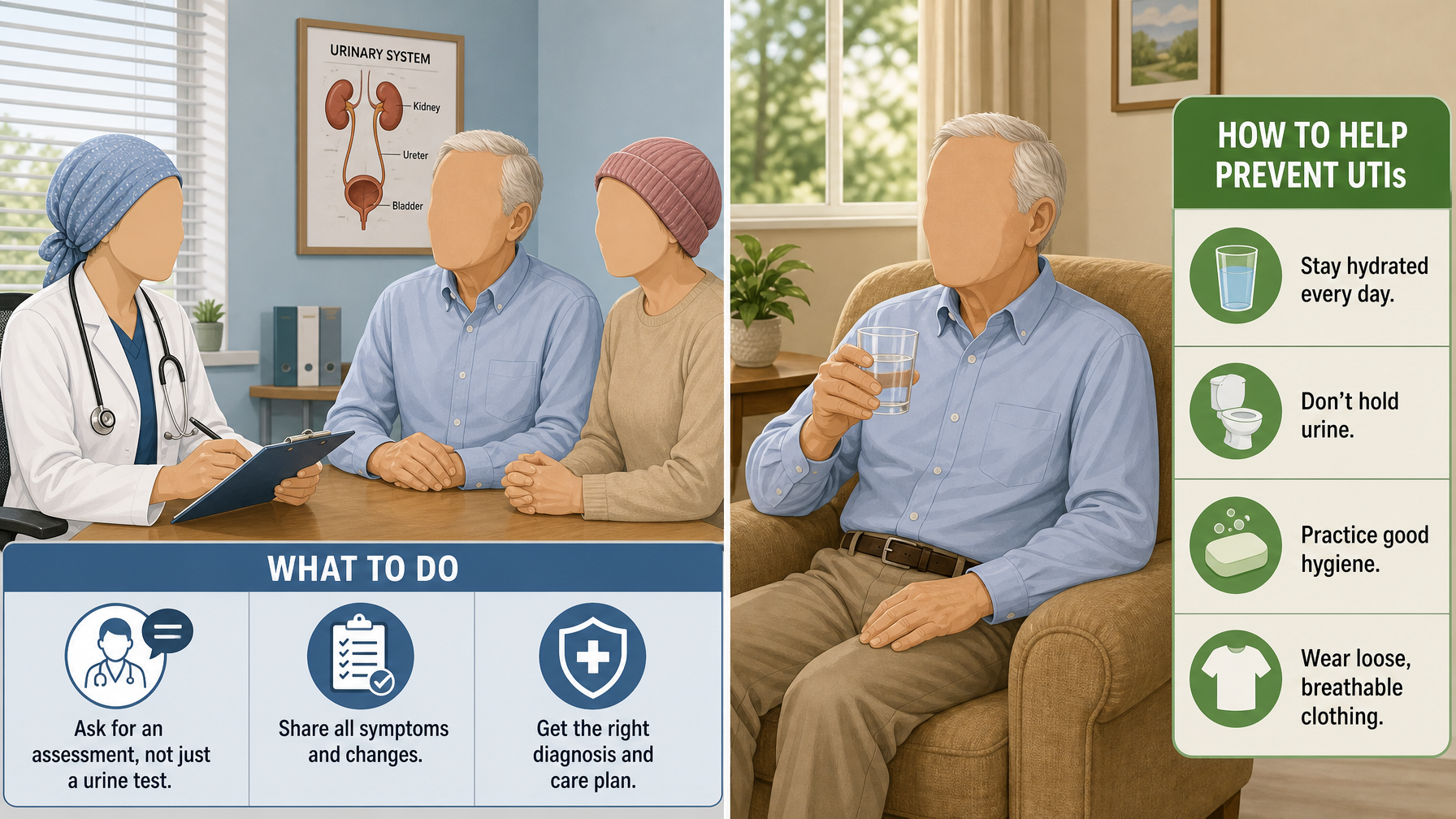
If you suspect a UTI:
- 1
Ask for an assessment, not just a urine test
A urine test is part of the picture, not the whole of it — bacteria in the urine are common in older adults who are not ill, so a positive result does not on its own explain the change. Describe what you have seen and when it started, and ask what is causing it.
- 2
Complete the treatment
If antibiotics are prescribed, finish the full course as directed, and expect the confusion or other symptoms to improve as the infection clears (though confusion can take longer to fully settle).
- 3
Watch for worsening
If fever, back pain, or severe confusion develop, escalate to urgent care.
- 4
Support prevention
Encourage good hydration (unless fluids are restricted), good personal and toileting hygiene, prompt changing if incontinence is present, and prompt treatment of constipation. Recurrent UTIs warrant a doctor’s review for underlying causes.
Watch out
Do not assume a sudden decline in someone with dementia is "just the dementia." Getting a prompt medical assessment to find the cause is one of the most valuable things you can do when a person with dementia suddenly worsens.
Frequently asked questions
What are the signs of a UTI in an elderly person?
In seniors, watch for new or worsening urinary symptoms (burning, urgency, frequency) and other signs of infection, though these can be less obvious in frail older adults. Sudden confusion, agitation, new incontinence, weakness or increased sleepiness can occur alongside a UTI, but these are nonspecific and have many other causes. Falls tend to follow from the drowsiness and confusion rather than being a sign of the infection itself. Any sudden change warrants medical assessment.
Can a UTI cause confusion in the elderly?
Confusion can occur alongside a UTI in older adults, but it’s nonspecific — many other conditions can cause sudden confusion too, including dehydration, medication effects, constipation, or other infections. In someone with dementia, a sudden worsening of confusion is worth a prompt medical check rather than being assumed to mean a UTI specifically — a doctor can find the actual cause.
Why do UTIs cause different symptoms in seniors?
In older adults, especially the frail or those with dementia, the more typical urinary signs of a UTI can be less obvious. Confusion, agitation, falls, or decline can occur alongside a UTI, but these are nonspecific and have many other possible causes — they need medical assessment to find the actual cause, not an assumption that it’s a UTI. This is why a sudden change in an older adult is worth getting checked promptly.
When is a UTI an emergency in an elderly person?
Seek urgent or emergency care if there is fever, chills, or feeling very unwell, back or side pain (suggesting a kidney infection), severe confusion, drowsiness, or a sharp decline (possible sepsis), blood in the urine or inability to urinate, or signs of serious infection like rapid breathing or clammy, mottled skin. Untreated UTIs can progress to dangerous infection.
How is a UTI diagnosed and treated in seniors?
A urine test is usually part of it, but a positive result alone does not confirm the UTI is what is causing the change, because bacteria in the urine without infection is common at this age. Describe all the changes — including confusion or falls — and ask what is causing them. Treatment is typically a course of antibiotics, which should be completed fully; symptoms usually improve as the infection clears, though confusion can take a little longer to fully settle. Worsening signs need urgent care.
How can I help prevent UTIs in my elderly parent?
Encourage good hydration (unless fluids are restricted), good personal and toileting hygiene, prompt changing if incontinence is present, and prompt treatment of constipation. If UTIs keep recurring, ask the doctor to review for underlying causes. Prevention can lower the chance of infection, and with it the confusion and falls that can follow.
Should my parent get antibiotics if the urine test is positive?
Not automatically. Bacteria in the urine without urinary symptoms is common in older adults and is called asymptomatic bacteriuria — treating it with antibiotics does not improve outcomes and carries real harm, including the chance of C. difficile infection and antibiotic resistance. The 2019 Infectious Diseases Society of America guideline advises that when an older adult has bacteria in the urine with new confusion or a fall, but no urinary symptoms, no fever and no signs of sepsis, the doctor should assess for other causes rather than prescribe antibiotics. A sudden change still needs same-day assessment — but ask the doctor to find the cause, not to prescribe antibiotics. Where there are urinary symptoms, fever, or signs of sepsis, that points to an infection that needs urgent assessment and treatment.
Sources
- Clinical Infectious Diseases (Norman, 2000). Fever in the Elderly
- Infectious Diseases Society of America. Clinical Practice Guideline for the Management of Asymptomatic Bacteriuria (2019 Update)
- CDC. About Sepsis
- MedlinePlus (U.S. National Library of Medicine). Delirium
