
6 Best Stair Assist Devices for Elderly
 By Kutubuddin, Founder & Senior Care Researcher Updated October 2026
In this guide
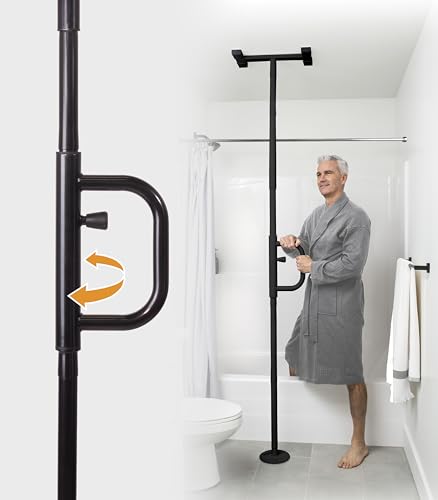 Best for landingsStander Security Pole & Curve Grab Bar
 Best for entry stepsU-Shape Wall-Mount Step Handrail (1–3 Steps)
 Best second handrail6 ft ADA Handrail Kit (Satin-Anodised Aluminium)
 Best underfoot gripCOSY HOMEER Non-Slip Stair Landing Rug (20 x 32 in)
 Best tread gripCOSY HOMEER Non-Slip Stair Tread Mats (15-Pack)
 Best edge protectionAluminium Stair Nosing, 36 in
- What to look for
- Frequently asked questions
Falls on stairs are among the most dangerous falls for seniors — height, forward momentum and hard surfaces make them far more likely to cause serious injury than a fall on level ground. What helps depends entirely on what the stairs are missing.
We may earn a commission when you buy through links on this page. Read our affiliate disclosure.
Top 6 Picks — Find Your Situation
#1 · Best for landings
Stander Security Pole & Curve Grab BarBest for: The top or bottom of a flight, where the handrail ends and there is nothing to hold before stepping away
#2 · Best for entry steps
U-Shape Wall-Mount Step Handrail (1–3 Steps)Best for: A front door step, garage step, porch or garden entry with no rail at all
#3 · Best second handrail
6 ft ADA Handrail Kit (Satin-Anodised Aluminium)Best for: A staircase missing a rail on one side — the most valuable stair modification most homes can make
#4 · Best underfoot grip
COSY HOMEER Non-Slip Stair Landing Rug (20 x 32 in)Best for: The landing at the top or bottom of a bare wooden or laminate flight
#5 · Best tread grip
COSY HOMEER Non-Slip Stair Tread Mats (15-Pack)Best for: Bare wooden or laminate stairs, especially in a house where people go about in socks
#6 · Best edge protection
Aluminium Stair Nosing, 36 inBest for: Worn or rounded step edges, and any staircase where the steps blur into one another visually
A second handrail on the open side is the highest-impact change most homes can make, and a proper ADA-specification rail at 1.6 inches diameter is one a hand can actually close around. The treads need two different things: mats for grip on the flat, and nosing for the edge, where a foot really catches. A tension-mounted pole covers the landing, where every staircase rail stops. Most homes need more than one of these.
A closer look at our top pick
Stander Security Pole & Curve Grab Bar
Best for: The top or bottom of a flight, where the handrail ends and there is nothing to hold before stepping away
- Mount
- Tension, floor to ceiling — no drilling
- Ceiling fit
- 7–10 ft
- Capacity
- 300 lb
- Grip
- Curved bar, adjustable height
Independently researched · Updated October 2026
The Stander Security Pole earns the top spot because it solves the problem that wall rails do not: the landing. When the handrail on the staircase ends, the senior still has to turn, reorient, and walk away from the stairs without anything to hold. The pole sits at the landing, provides a firm grip at the right height, and can be moved to a different location in minutes if the need changes.
The tension-mount design means no drilling, no permanent modification to the home, and no need to locate studs. The curved grab bar with four locking positions lets both shorter and taller users find the right angle. At 300-pound capacity with a lifetime frame warranty, it is built to last.
What we love
- Fixes the landing gap that every wall rail leaves
- No drilling, so it suits renters and finished walls
- Curved bar can be set to whatever height and angle helps
- Moves with you if the need changes rooms
- Well established design with a long track record
Things to consider
- Needs a solid ceiling above — not a suspended or sloped one
- Takes up floor space at the landing, which matters in a tight hallway
- Does nothing for the stairs themselves — pair it with a rail
- Tension must be re-checked periodically as floors and ceilings move
Right for you if
- ✓Stair landing where the rail ends and additional grip is needed
- ✓Renters or homeowners who cannot or do not want to drill
- ✓Flexible placement — useful by the bed, toilet, or sofa too
Maybe skip it if
- !Staircases missing a wall rail on one side (wall-mount a rail)
- !Slippery step treads (add tread mats and nosing)
- !Single entry steps (a short U-shape wall rail is more practical)
What owners consistently report
Common praise
- +Families installing it for elderly parents report it was used immediately and consistently
- +No-drill installation is consistently praised by renters and by families who do not want to modify their home
- +The adjustable curved bar is noted as comfortable for a wide range of users in the same household
Common gripes
- –Requires a flat ceiling — does not work under sloped or vaulted ceilings
- –Check the ceiling height before ordering; at least 7 ft required
- –Re-tension after the first week of use to confirm it remains secure
Getting started
- →Measure ceiling height first — the pole fits flat ceilings from 7 to 10 ft
- →Tension should be firm enough that the pole cannot slide; re-check after first few uses
- →Position the curved bar at the height the senior will grip it naturally while standing
How it compares
For a staircase missing a rail on one side, the 6 ft ADA handrail kit is the more valuable fix — a proper second rail, fixed into studs, that serves the whole flight. Choose the Stander for the landing and for anywhere drilling is not an option; choose the ADA kit when the stairs themselves are the problem.
How we picked
We compared 6 options. Our picks are based on product specifications, occupational-therapy guidance on stair safety, and verified user and caregiver reviews — not independent testing. We prioritised products that address real stair safety gaps rather than products that duplicate existing support already in the home. Key questions: does the senior already have one handrail but need a second on the other side? Is the issue balance at the landing or step? Is permanent installation possible, or does the living situation (rental, etc.) require a no-drill option? An occupational therapist can assess which type of device is appropriate for the specific senior and staircase.
Reviewed by Kutubuddin — who researches senior-care products and the real-world needs of caregivers and older adults.
Other picks, reviewed
U-Shape Wall-Mount Step Handrail (1–3 Steps)
The most overlooked fall risk in the house is the front-door step, and almost no home has anything to hold there. This is a short U-shaped rail that mounts to the wall beside one to three steps, indoors or out, in powder-coated steel. It is not a staircase rail and does not pretend to be — it is a handhold at the exact point where someone steps up from a path or down into a garage, which is where a great many senior falls actually happen.
What we like
- Covers the entry step, which most homes leave completely unprotected
- Powder-coated for outdoor use on a porch wall
- Short run means one person can fit it in an afternoon
- U-shape gives a grip going both up and down, not just one direction
- A smaller, simpler fitting than a full staircase rail
Keep in mind
- Needs a solid wall beside the steps — no wall, no rail
- Only spans one to three steps; a full flight needs a proper handrail
- Fixings must suit the wall material — masonry, brick and siding all differ
- Check the height against the person before drilling; it cannot be adjusted after
- Type
- U-shape wall-mounted grab rail
- Suits
- 1 to 3 steps
- Finish
- Powder-coated steel, black
- Use
- Indoor or outdoor
- Mount
- Wall-fixed
6 ft ADA Handrail Kit (Satin-Anodised Aluminium)
If a staircase has a rail on one side only, adding a second one is the single highest-impact change you can make — it lets someone use their stronger hand in both directions, and gives something to grab whichever way they fall. This kit is built to ADA specification and two details earn it the pick. The rail is **1.6 inches in diameter**, inside the graspable range the standard defines, so a hand actually closes round it rather than resting on top. And it has **wall returns** — the ends curve back into the wall instead of stopping in mid-air, which stops a sleeve or a bag strap catching on the end. That is a practical safety detail, not just a finishing touch. The four brackets pivot, so the rail follows the pitch of the stairs.
What we like
- A second handrail is the highest-impact stair change there is
- 1.6 in diameter lets the hand close around it, which a wide flat rail does not
- Wall returns stop sleeves and straps catching on an open end
- Pivoting brackets follow the stair pitch without custom fabrication
- Anodised aluminium suits indoor or outdoor use and will not rust
Keep in mind
- Must be fixed into studs or solid blocking — drywall anchors alone are not safe here
- 6 ft covers a short flight; a long staircase needs two kits and a joint
- Requires a drill, a stud finder and a level to fit correctly
- Getting the height right matters more than the product — measure before drilling
- Length
- 6 ft
- Diameter
- 1.6 in — within the ADA graspable range
- Material
- Satin-anodised aluminium
- Brackets
- 4, pivoting to the stair pitch
- Ends
- ADA wall returns
COSY HOMEER Non-Slip Stair Landing Rug (20 x 32 in)
The landing is where the foot lands after the last step and then turns, and on bare wood in socks that turn is one of the most common ways an older person goes down at home. This is a single 20 by 32 inch rug for exactly that spot. It peels and sticks on a TPE backing rather than a wet adhesive, so it lifts off without residue — which matters in a rental, and matters again when it needs replacing — and it can be repositioned if it goes down crooked. Polyester, so it washes rather than being thrown away.
What we like
- Covers the turn at the end of the flight, where the footing changes
- Peels off cleanly with no residue — safe for a rental
- Repositionable, so a crooked one can be lifted and re-laid
- Washable rather than disposable
Keep in mind
- One rug for the landing — it does nothing for the treads themselves
- Adhesive grip weakens on a dusty or waxed floor; clean thoroughly first
- Edges can lift over time and become a trip hazard — check monthly
- Beige will show wear in a busy hallway
- Size
- 20 × 32 in
- Coverage
- One landing, not the treads
- Backing
- TPE non-skid, repositionable
- Material
- 100% polyester
- Fitting
- Peel and stick, no wet adhesive
COSY HOMEER Non-Slip Stair Tread Mats (15-Pack)
Wooden and laminate stairs taken in socks are one of the most common ways an older person falls at home, and covering the treads is the change that costs least effort. Fifteen mats at 28 by 9 inches cover a typical flight. They peel and stick on a TPE backing rather than a wet adhesive, so they lift off without residue — which matters in a rental, and matters again when they need replacing — and a crooked one can simply be lifted and re-laid. At 0.4 inches the profile is low enough that a door at the top of the stairs still clears, and they wash around thirty times without losing grip rather than being thrown away.
What we like
- Covers every tread, which is where the foot actually slips
- Peels off cleanly with no residue — safe for a rental
- Repositionable, so a crooked one can be lifted and re-laid
- Low profile, so a door at the top of the stairs still clears
- Washable rather than disposable
Keep in mind
- A 15-mat set is a bigger purchase than a single rail — check the current price on Amazon
- Adhesive grip weakens on a dusty or waxed stair; clean thoroughly first
- Edges can lift over time and become a trip hazard themselves — check monthly
- Fifteen mats over-buys for a short flight
- Beige will show wear on a busy staircase
- Size
- 28 × 9 in, 0.4 in thick
- Quantity
- 15 mats — a typical flight
- Backing
- TPE non-skid, repositionable
- Material
- 100% polyester
- Washable
- ~30 washes
Aluminium Stair Nosing, 36 in
A foot does not usually slip in the middle of a step — it catches on the edge. Nosing wraps that edge in fluted aluminium, giving grip exactly where the ball of the foot lands and, just as usefully, marking where each step ends. That visual line matters more with age than most people realise: depth perception on a flight of same-coloured steps is one of the quiet reasons older adults misjudge the last one. Each strip is 4.5 inches across the top and 1.5 down the face, cuts to width with snips, and can be glued or screwed.
What we like
- Protects and grips the step edge, which is where feet actually catch
- Defines each step visually — helps with the depth perception lost with age
- Aluminium outlasts any tape and will not peel at the nose
- Trims to width with snips; no pre-drilled holes to work around
- Can be glued for a rental or screwed for permanence
Keep in mind
- One strip per step — a full flight needs several, so cost adds up
- Adds a few millimetres of height at the edge; fit every step, not some
- Cutting aluminium cleanly needs the right snips and a steady hand
- Harder to remove than tape if screwed down
- Length
- 36 in, cuttable
- Profile
- 4.5 in top, 1.5 in face
- Material
- Satin-anodised aluminium
- Surface
- Fluted anti-slip
- Fixing
- Glue-down or screw
What to look for
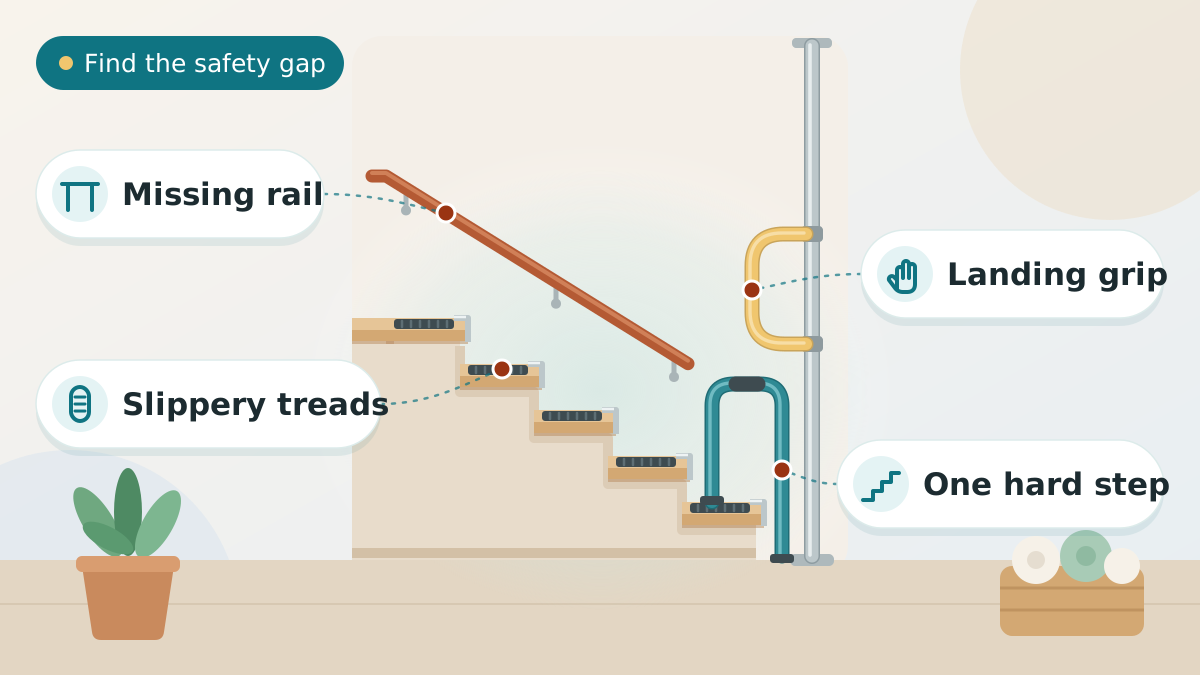
Identify the specific stair problem first
Stair falls have several distinct causes, and the right aid depends on which one applies:
- Missing second rail: the staircase has a rail on one wall and nothing on the open side. Solution: fit a second handrail into the studs — the highest-impact change on this page.
- Slippery treads: the steps themselves are smooth, worn, or have poor traction. Solution: non-slip tread mats on the flat surface, and aluminium nosing on the edge of each step.
- Landing problem: the senior negotiates the stairs but needs something to hold at the top or bottom when the rail ends. Solution: a tension-mounted security pole at the landing.
- Single difficult step: a front-door step, porch entry, or garage riser with nothing to hold. Solution: a short U-shape rail mounted to the wall beside it.
Many homes have more than one issue. Tread grip and a landing pole are frequently needed together even when a wall rail is already present.
Permanent installation versus no-drill options
Wall-mounted rails fixed into studs are the most secure and load-bearing option, and they are the right long-term answer in an owned home. For renters, or where drilling is genuinely not possible, the alternatives are tension-mounted poles at the landing and peel-and-stick tread mats on the steps — both of which come away without damage. Be clear that these are a second-best: nothing that is not fixed to structure will take a person’s full weight in a stumble, and a rail is what does that.
Where installation is possible, a wall-mounted rail is generally the sturdiest option for stair safety. The no-drill alternatives are meaningful improvements over nothing, but are secondary where installation can be done.
Height and weight capacity
Grab rails and poles need to be at a height the senior can actually reach and grip while upright. The standard recommended handrail height is 34–38 inches from the stair nosing. Check that the selected product either fits this range or is adjustable to it. Weight capacity should always exceed the user’s weight — a transfer from slipping to grabbing a rail can involve significantly more than standing body weight.
When stairs become too risky
Stair safety aids reduce fall risk; they do not eliminate it. If a senior has had repeated near-falls or falls on the stairs, significant balance impairment, or is recovering from surgery where full weight-bearing on the stairs is contraindicated, a stair lift or single-floor living arrangement may be the right solution rather than adding more safety devices to the current staircase. An occupational therapist can advise on which level of intervention is appropriate.
Read more:How to Help an Elderly Person Stand Up SafelyElderly Parent Keeps Falling?Fear of Falling in the Elderly
Tips to Choose Stair Assist Devices
Short on time? Here are the key points to weigh before choosing, each covered in detail above:
- Identify the specific stair problem first
- Permanent installation versus no-drill options
- Height and weight capacity
- When stairs become too risky
Comparing options? See our guides to Best Canes for Seniors, Best Walkers for Seniors, and Best Rollators for Seniors.
Why stair falls are particularly dangerous for seniors
Stair falls are disproportionately severe because they involve both a sudden loss of balance and a surface that the person tumbles down rather than landing on immediately. The resulting injuries tend to be more serious than level-ground falls — hip fractures, head injuries, and spinal injuries are all more common in stair falls. CDC data consistently identifies stairs as one of the highest-risk fall locations in the home for older adults.
This is why preventive investment in stair safety tends to be high-value: a stair fall injury such as a hip fracture can lead to substantial medical care. The conversation about stair safety is often more appropriately framed as injury prevention than as an admission of reduced ability.
Working with an occupational therapist for a home stair assessment
An occupational therapist (OT) can visit the home and assess every stair safety issue — tread condition, rail height, landing support, lighting, and the senior’s specific balance and mobility limitations — and recommend the exact interventions needed. In the US, this is sometimes available through Medicare as part of a home health assessment. In the UK, local authority OTs provide home assessments at no cost in many areas. A professional stair assessment gives a complete picture that a buying guide cannot replace.
Frequently asked questions
It depends on which safety gap the staircase has. For a missing wall rail, a stud-mounted ADA handrail kit is the most secure. For landing support without drilling, a tension-mounted security pole. For slippery treads, non-slip mats plus aluminium nosing on the edges. For a single entry step, a short U-shape wall rail. Most homes benefit from more than one intervention. An occupational therapist can identify which combination is needed.
Yes, where possible. Current building codes in the US and UK require handrails on at least one side of residential staircases, but older homes often have a rail on one side only. Adding a rail to the open side gives a handhold in both directions. A wall-mounted rail is the usual choice when both hands are needed for stair safety; an occupational therapist can advise on the specific staircase.
A wall-mounted rail requires drilling into studs for adequate load-bearing strength. No-drill alternatives are freestanding tension poles at the landing, and tread mats with a peel-and-stick backing on the steps themselves. These are meaningful improvements for renters or temporary situations but are secondary to a properly installed wall rail where that is possible.
Building codes in the US (IRC and ADA guidelines) specify stair handrails between 34 and 38 inches measured from the stair nosing. This height allows most adults to grip the rail naturally while upright on the stairs. Adjustable rails or grab handles can be set to match the correct height for the specific user.
Non-slip tread mats are the fastest and least expensive fix for the flat of the step, and aluminium nosing handles the edge — which is where a foot actually catches. Use both: mats on the tread, nosing on the nose. For carpeted stairs, re-securing loose or worn carpet and adding carpet stair pads under each tread reduce both trip and slip risk. Stair lighting (bright, consistent illumination of the treads) also makes each step easier to see at night.
A stair rail runs along the wall beside the staircase and provides grip for the full stair descent or ascent. A security pole is a freestanding floor-to-ceiling pole placed at the landing or another single point in the home. They solve different problems: a rail for the stairs themselves; a pole for the landing or room where the senior needs standing support.
Yes. If a senior has severe balance impairment, significant weakness, has had multiple stair falls, or is recovering from surgery where full weight-bearing on stairs is contraindicated, a stair lift provides powered assistance rather than just support. A stair lift moves the person up and down without them needing to bear weight or maintain balance on the stairs at all. An OT can advise on which level of intervention is appropriate.
Locate the wall studs along the staircase (use a stud finder). Mount the rail brackets into the studs at the correct height (34–38 inches from the stair nosing) and correct angle following the stair pitch. Confirm the rail is rigid before use. If DIY installation is not comfortable, a handyman or OT referral service can install grab rails professionally. In the UK, local authority occupational therapy services sometimes arrange installation at no cost.
A stair fall should prompt a full stair safety review: assess the tread condition, rail adequacy, lighting, and the senior’s balance and mobility. An OT home assessment is particularly valuable after a fall. If the senior is hesitant about stairs following a fall (which is common), that hesitancy is meaningful information — temporary avoidance of the stairs while the home is adapted is better than forcing confidence prematurely.
Peel-and-stick tread mats with a TPE backing are designed to lift off without residue, which makes them the safer choice in a rental — test one on a single step first. Aluminium nosing can be glued rather than screwed if holes are not acceptable, though glued nosing is harder to remove cleanly later. Confirm with a landlord before fixing anything permanently for situations where adhesive tape cannot be used.
The final verdict
Start with the treads — non-slip mats on the flat and aluminium nosing on the edge cost little and can be fitted this weekend. If one side of the staircase has no rail, fit one: a second handrail into studs is the single most valuable stair modification there is. Add a tension pole at the landing where the rail ends, and a short U-shape rail beside the front-door step if there is nothing to hold there. And be honest about the ceiling of what any of this achieves. These six make stairs meaningfully safer for someone who can still climb them. If a senior is stopping halfway to rest, pulling themselves up on the rail, or has already fallen on the stairs once, the answer is a stairlift or moving the bedroom downstairs — not a sixth accessory. An occupational therapist can assess which of those you are actually looking at.
Our overall winner is the Stander Security Pole & Curve Grab Bar. You can visit the official site.
Our Top 5 Picks at a Glance
Ready to choose? Here are the top 5 again.
Best for landings
Stander Security Pole & Curve Grab Bar
Best for entry steps
U-Shape Wall-Mount Step Handrail (1–3 Steps)
Best second handrail
6 ft ADA Handrail Kit (Satin-Anodised Aluminium)
Best underfoot grip
COSY HOMEER Non-Slip Stair Landing Rug (20 x 32 in)
Best tread grip
COSY HOMEER Non-Slip Stair Tread Mats (15-Pack)
Affiliate links — we may earn a commission.
More reviews
