
Daily Living Aids · Reviews
Best Sock Aids for One-Handed Use: Stroke & Hemiplegia Picks (2026)
True one-handed dressing has one purpose-built answer, and it leads this list: the Kinsman Enterprises Sock Aid, whose weighted, non-slip base plants itself on the floor so a single hand only has to pull — the design used in stroke rehabilitation programs. The rest of the field works one-handed by technique rather than by design: gather both of the Maddak’s loops into one hand and its low-friction shell pulls on smoothly; the semi-rigid RMS holds its own shape while a single hand works, and the Vive’s long ropes gather into a one-hand pull at lap height. This is a shorter list than our other sock aid guides on purpose — the market for genuinely one-handed designs is small, and we would rather rank four honest options than pad to five. New one-sided weakness deserves an occupational therapist’s input; for the wider field, see the full best sock aids for elderly guide, and for the rest of a single-hand dressing kit, our dressing aids review.
We may earn a commission when you buy through links on this page. Read our affiliate disclosure.

Our Top Pick
Kinsman Enterprises Sock Aid
This is the only aid here designed for one hand from the ground up: a weighted base with a non-slip bottom plants itself on the floor, so nothing needs steadying while your working hand pulls the single handle.
- Purpose-built for one-handed use
- Weighted base stays planted — no second hand to steady it
- Occupational-therapist designed
- Common in stroke rehabilitation programs
Type
One-handed, weighted base
Handle
Single-handle pull
Base
Weighted, non-slip
How we picked
We compared 4 options. Our picks are based on manufacturer specifications, stroke-rehabilitation dressing technique, and verified owner reviews — not independent lab testing. For one-handed use we weighted self-bracing (does the aid hold itself, or does it need a second hand), whether handles gather into a single-hand pull, shell behavior during slower one-hand loading, and learning curve. Only four picks appear here because only these earn a one-handed recommendation — we do not pad lists. After a stroke or new arm injury, an occupational therapist should guide the dressing program.
Reviewed by SK Kutubuddin — who researches senior-care products and the real-world needs of caregivers and older adults.
Our picks, reviewed
Kinsman Enterprises Sock Aid
This is the only aid here designed for one hand from the ground up: a weighted base with a non-slip bottom plants itself on the floor, so nothing needs steadying while your working hand pulls the single handle. Occupational-therapist designed and a fixture of stroke rehabilitation, it turns the hardest dressing task of hemiplegia into a learnable routine.
What we like
- Purpose-built for one-handed use
- Weighted base stays planted — no second hand to steady it
- Occupational-therapist designed
- Common in stroke rehabilitation programs
Keep in mind
- Heavier than standard sock aids
- Higher learning curve at first
- Type
- One-handed, weighted base
- Handle
- Single-handle pull
- Base
- Weighted, non-slip
Maddak Deluxe Flexible Sock Aid

The standard OT workaround for one-handed dressing is gathering both handles into the working hand — and the Maddak is built for it: its fabric loops stack neatly in one grip, the nylon-lined shell pulls on with less force than any rope model, and the terry exterior keeps the sock from creeping off during slower one-hand loading.
What we like
- Nylon interior slides socks on with less pulling force
- Loop handles suit a weak or painful grip
- Three-finger shell flexes around the heel
- Long-standing, widely available design
Keep in mind
- Very flexible shell can fold on thick socks
- Straps are shorter than the longest rope models
- Type
- Flexible three-finger shell
- Handles
- 29-inch straps, loop grips
- Lining
- Nylon inside, terry outside
RMS Deluxe Sock Aid

Loading a sock one-handed is the slow part, and the RMS’s semi-rigid shell makes it forgiving: it holds its shape on your lap while a single hand works the sock over it, the notches keep the sock positioned, and the terry lining stops mid-pull slips. Gather the two handles into one hand for the pull.
What we like
- Semi-rigid shell keeps the motion controlled
- Terry lining grips the sock — fewer re-loads
- Built-in notches hold the sock in position
- The style physical therapists commonly recommend
Keep in mind
- Slightly heavier than flexible models
- Small learning curve at first
- Type
- Semi-rigid shell sock aid
- Lining
- Terry cloth sock grip
- Handles
- 32-inch length
Vive Sock Aid
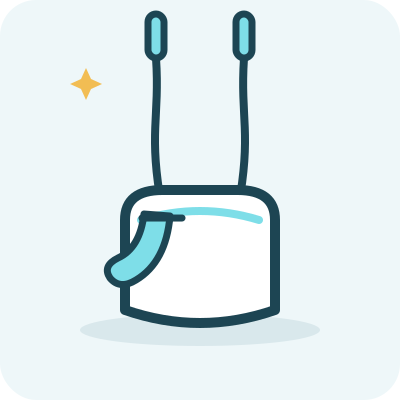
The Vive’s 33-inch ropes gather into a single-hand pull that stays at lap height — useful when the working arm also has limited reach. The foam grips pad a doubled-up hold, and the light shell asks little of one arm. Expect a few more loading attempts than the semi-rigid RMS.
What we like
- Longest handles on our list
- Foam grips are easy on stiff hands
- Lightweight and portable
- Works with most sock types
Keep in mind
- Not suitable for compression stockings
- Rope handles may fray over time
- Type
- Flexible shell sock aid
- Handles
- 33-inch ropes, foam grips
- Weight
- About 4 oz
What to look for
What matters in a one-handed sock aid
Judge every candidate against the realities of a single working hand:
- Self-bracing first: the aid must hold still without a second hand — a weighted base does it by design; semi-rigid shells partially; floppy shells not at all.
- Handles that gather: two straps must stack comfortably into one grip — fabric loops do this best, thin cords worst.
- Forgiving loading: one-handed sock loading is slow, so shells that hold their shape and linings that grip the sock prevent constant restarts.
- Weight trade-off: a weighted base is stability during use but heavier to retrieve and store — keep it within easy reach of the dressing chair.
The one-handed technique, step by step
Stroke-rehab programs teach single-hand sock dressing in this order:
- Sit supported with the working side toward a table or armrest; place the aid on the floor slightly toward the working side.
- Load the sock on your lap: anchor the shell against your thigh or between your knees, then work the sock over it with the working hand.
- Lower the aid on its gathered handles (or position the weighted base), guide the foot in — dressing the affected leg first while energy is highest.
- Pull upward toward the hip in one motion, keeping the trunk tall — let the base or shell do the bracing, not your teeth or your affected arm.
Expect a longer learning curve than two-handed use — a week or two of daily practice is normal after a stroke. An occupational therapist can shortcut it considerably and check that the technique fits your specific recovery stage.
Frequently asked questions
The weighted Kinsman design leads because it braces itself — the core problem of hemiplegic dressing. Pair it with the affected-side-first technique from stroke rehab, and involve the occupational therapist guiding your recovery.
Often, yes: gather both handles into the working hand and pull. Loop handles (Maddak) gather best; a semi-rigid shell (RMS) makes the slow one-handed loading step far more forgiving.
The affected or weaker leg first — while strength and patience are highest — then the stronger leg. The same order applies to trousers and shoes in most rehab dressing programs.
Longer than standard use: a week or two of daily practice is typical after a stroke, less for a temporary arm injury. Loose cotton socks first, everyday socks once the sequence is automatic.
A long-handled shoehorn, elastic shoelaces or slip-on shoes, a buttonhook, and a reacher grabber cover most of the rest. Our dressing aids review walks through the full kit.
The final verdict
Our overall winner is the Kinsman Enterprises Sock Aid — our best overall one-handed for most seniors. You can check the current price on Amazon to see today’s deal.
Keep comparing
