
How to Calm a Dementia Patient: Techniques That Work

Educational guidance based on person-centered dementia-care principles; not medical advice. Sudden or severe agitation can signal a treatable medical problem — see below.
When someone with dementia becomes agitated or distressed, the way you respond can calm the storm or fuel it. These techniques — rooted in meeting emotions and needs — help you bring calm, gently.
Key takeaways
- Your calm sets the tone — the person mirrors your emotional state, so a steady, gentle presence is your most powerful tool.
- Validate feelings, never argue. Respond to the emotion behind the words rather than correcting facts.
- Find the trigger — agitation is usually an unmet need (pain, fear, hunger, overstimulation), and meeting it often eases the distress.
- Redirect and soothe — shift gently to a calming activity, music, or comfort rather than confronting the behavior.
- Sudden or severe agitation is a medical red flag — check for pain, infection, or medication effects, especially if it is new.
Quick answer
How do you calm someone with dementia who is agitated?
Stay calm yourself — the person mirrors your tone. Validate the feeling ("You seem frightened — I’m here with you") instead of arguing or correcting. Look for the trigger (pain, hunger, needing the toilet, fear, overstimulation) and meet that need. Reduce stimulation, lower your voice, and gently redirect to a soothing activity, familiar music, or a comforting object. Avoid reasoning, quizzing, or restraining. If agitation is sudden or severe, have a doctor check for a treatable cause.
Start with your own calm
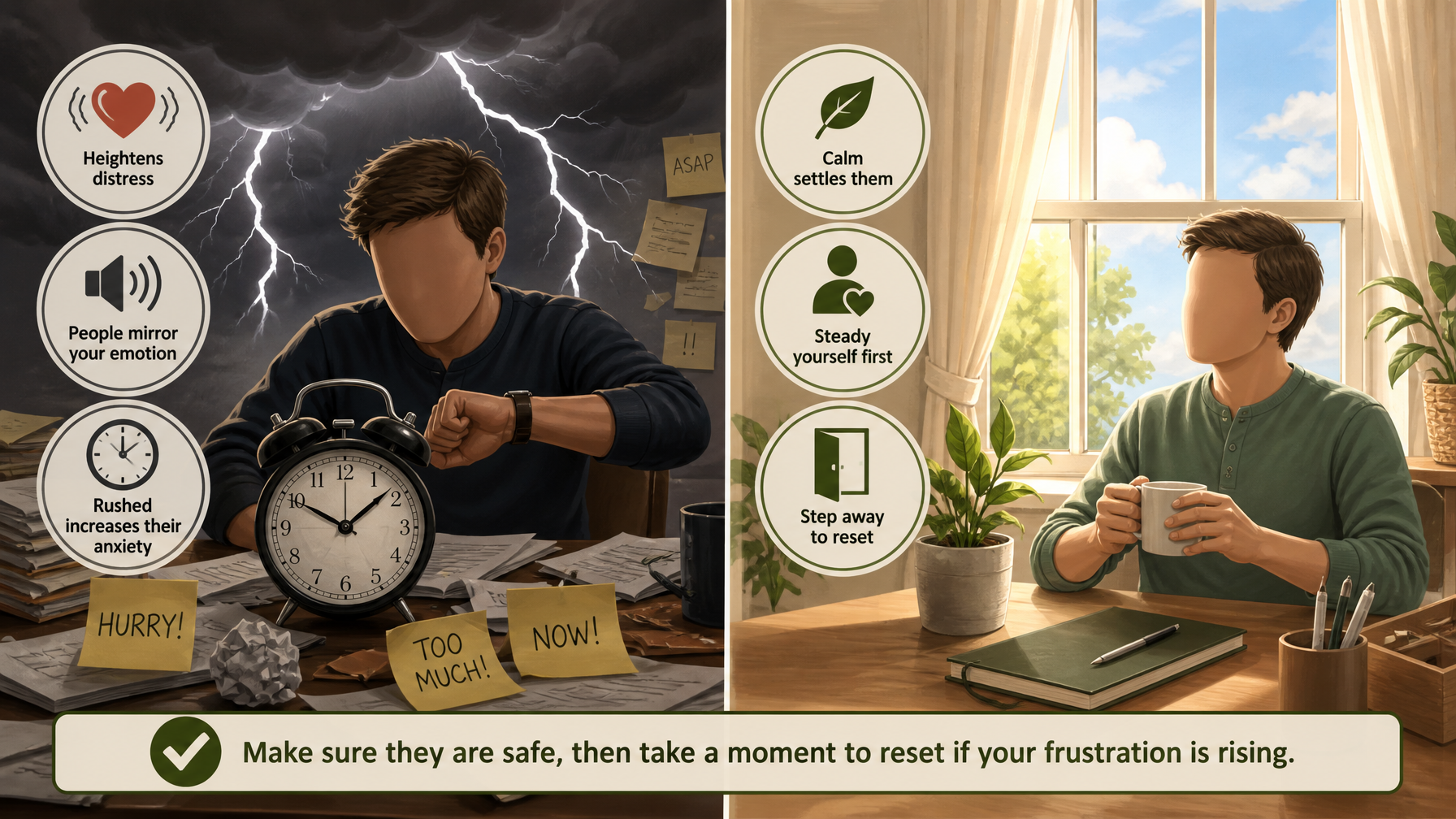
Before any technique, there is a foundation: your own emotional state. People with dementia become highly attuned to feelings and tone even as words lose meaning, and they mirror the emotion around them. An anxious, frustrated, or rushed approach heightens their distress; a calm, warm, unhurried one settles it.
So the first move when someone is agitated is to steady yourself — take a breath, lower your shoulders, slow down. This is genuinely hard in a tense moment, especially when you are exhausted, but it can make a real difference. If you feel your own frustration rising to the point of losing patience, it is okay to ensure the person is safe and step away for a moment to reset.
Good to know
Calm is contagious — and so is agitation. When you can slow your own breathing and soften your voice and face, you give the person’s nervous system something steady to match.
An ElderlyDaily original
Want the whole thing in one place?
Dementia Caregiver Command Center
- Daily care and medication logs in one place
- Behaviour-pattern tracking, to spot what makes a day harder
- Safety pages and caregiver handoff sheets for family and respite helpers
One-off purchase. Instant download.
Fillable PDF · US Letter + A4

Sponsored Pick
American Lifetime Day Clock
Seniors who need a clear, large-print day-and-date clock they can read across a room
Check PriceValidate feelings, do not argue
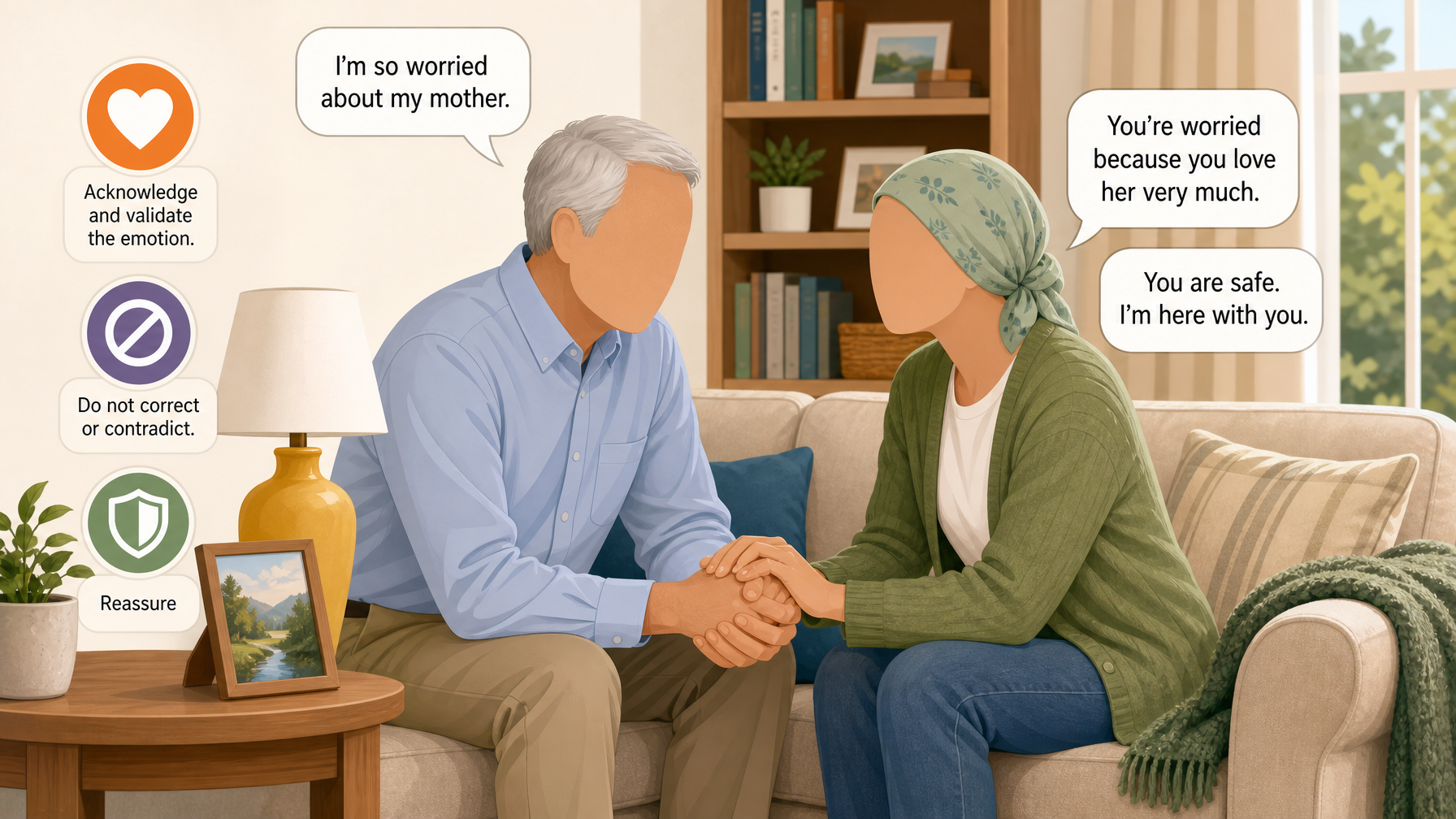
The most important communication principle in dementia is to meet the person’s emotional reality rather than forcing them into ours. When someone is distressed about something that is not factually true — wanting to go to a job they retired from, or looking for a parent long deceased — arguing the facts causes fresh pain and deeper agitation every time.
- Acknowledge and validate the emotion. "You’re worried about your mother — you love her very much." This meets the real need (the feeling) without lying about facts you can leave unsaid.
- Do not correct or contradict. Avoid "No, your mother passed away" or "You don’t work anymore" — these re-inflict loss and rarely land.
- Reassure. A calm "You’re safe, I’m here, everything is okay" addresses the underlying fear directly.
- Use their reality to bring comfort, then gently move toward calm — this is the essence of a peaceful interaction, echoed across dementia care at home.
Find the trigger — agitation is a message
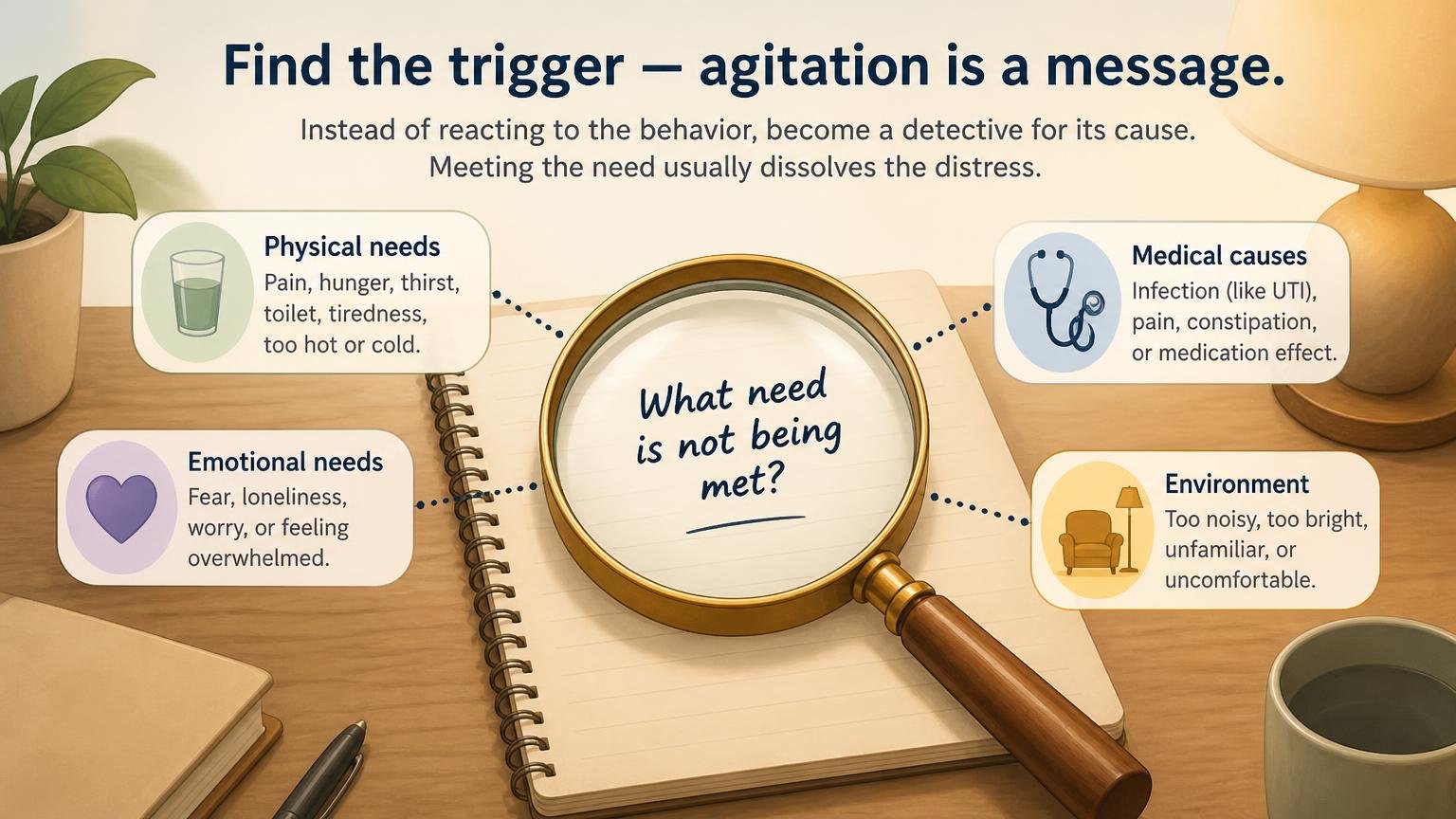
Agitation in dementia is almost always communication of an unmet need the person can no longer name. Rather than reacting to the behavior, become a detective for its cause — because meeting the need usually dissolves the distress:
- Physical needs — pain or discomfort, hunger, thirst, needing the toilet, tiredness, or being too hot or cold.
- Medical causes — a sudden change is often a treatable problem, especially infection like a UTI, pain, constipation, or a medication effect.
- Environment — too much noise, activity, or people; a chaotic or unfamiliar setting; or the low light and shadows of sundowning.
- Emotional needs — fear, loneliness, boredom, or frustration at not being understood.
For persistent or severe aggression specifically, our handling dementia aggression guide goes deeper.
Watch out
Sudden, out-of-character agitation is a medical red flag. Before assuming it is the dementia, have the person checked for pain, infection, constipation, or a medication problem — these are common, treatable triggers.
Communicate to soothe
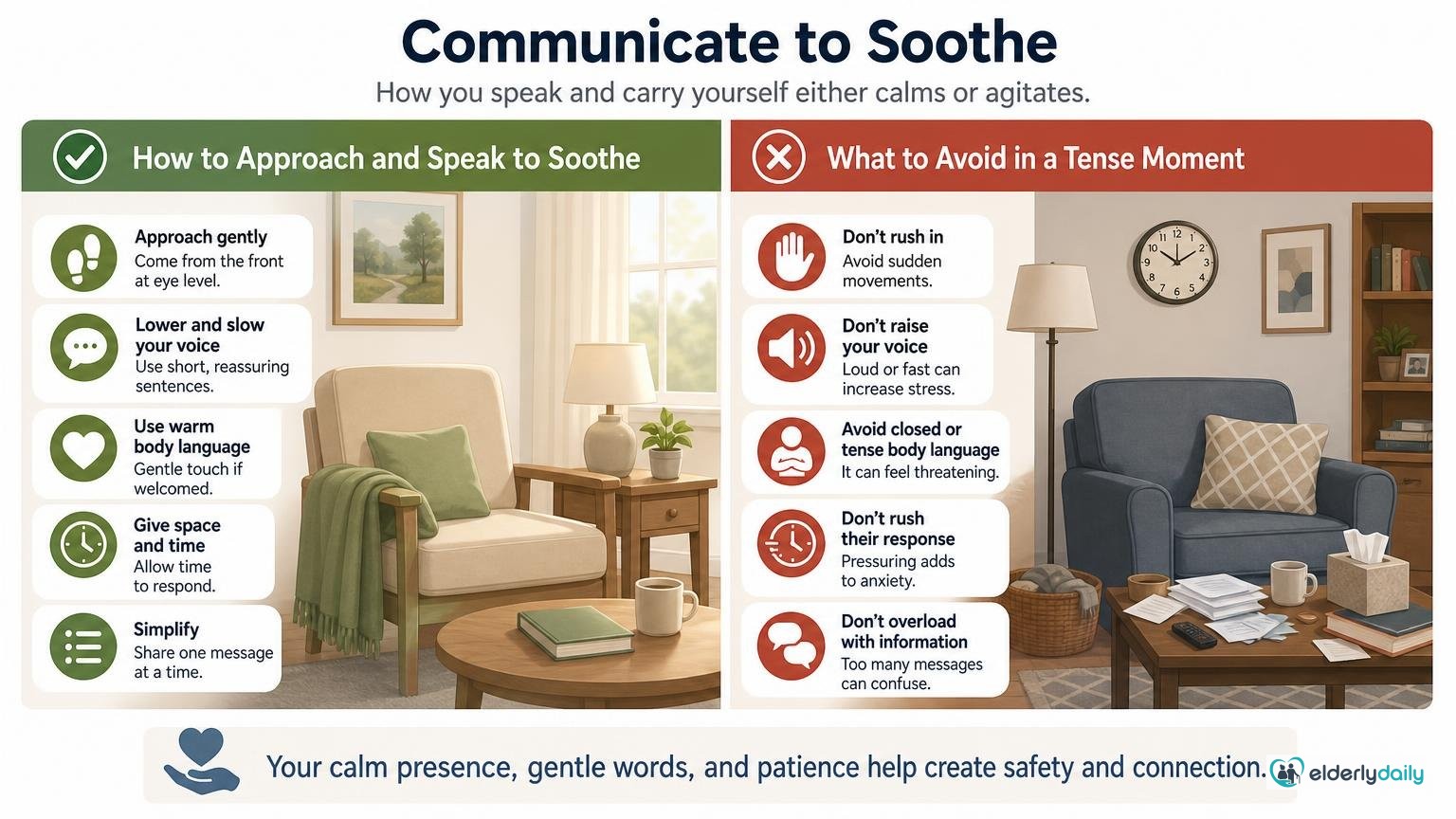
How you speak and carry yourself either calms or agitates. In a tense moment:
- Approach gently — from the front, at eye level, moving slowly so you do not startle.
- Lower and slow your voice, using short, simple, reassuring sentences.
- Use warm body language — a relaxed face, open posture, and, if welcomed, gentle touch on the hand or shoulder.
- Give space and time — do not crowd or rush; allow them time to process and respond.
- Simplify — one message, one question at a time; too many words overwhelm.
Redirect and soothe
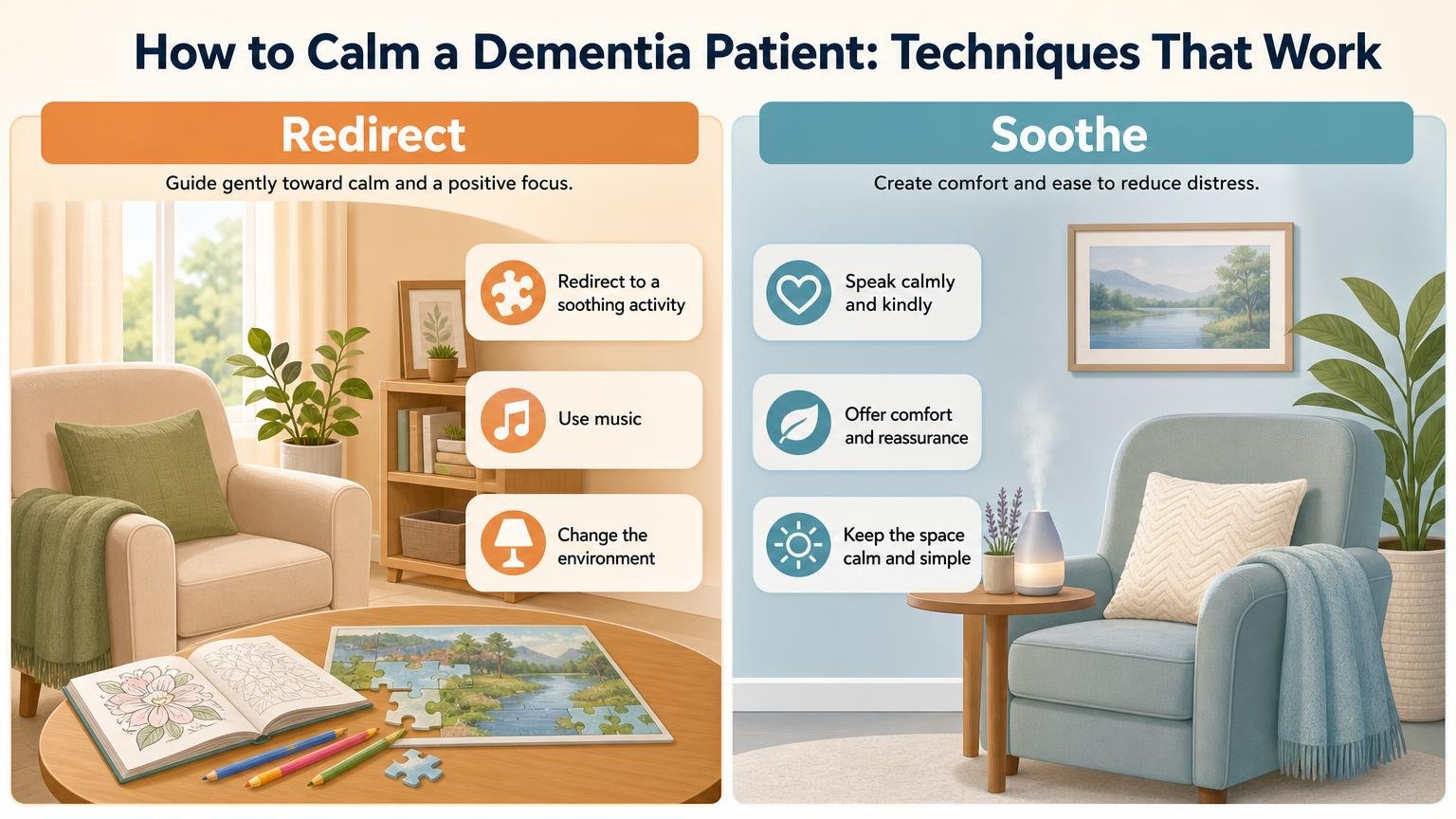
Once you have acknowledged the feeling and eased the immediate pressure, guide the person gently toward calm rather than dwelling on the upsetting topic:
- Redirect to a soothing activity — a simple task, folding towels, looking at a photo album, or a favourite puzzle or gentle activity.
- Use music — familiar songs from the person’s youth are remarkably calming and reach people even in advanced dementia.
- Change the environment — move to a quieter room, step outside for fresh air, or take a gentle walk together.
- Offer comfort — a favourite blanket or object, a warm drink, or simply sitting together holding hands.
- Meet the basic need you identified — offer the toilet, a snack, or rest.
Gentle conversation can help too; our fun questions to ask dementia patients offers easy, pleasant prompts that reconnect and soothe.
What to avoid
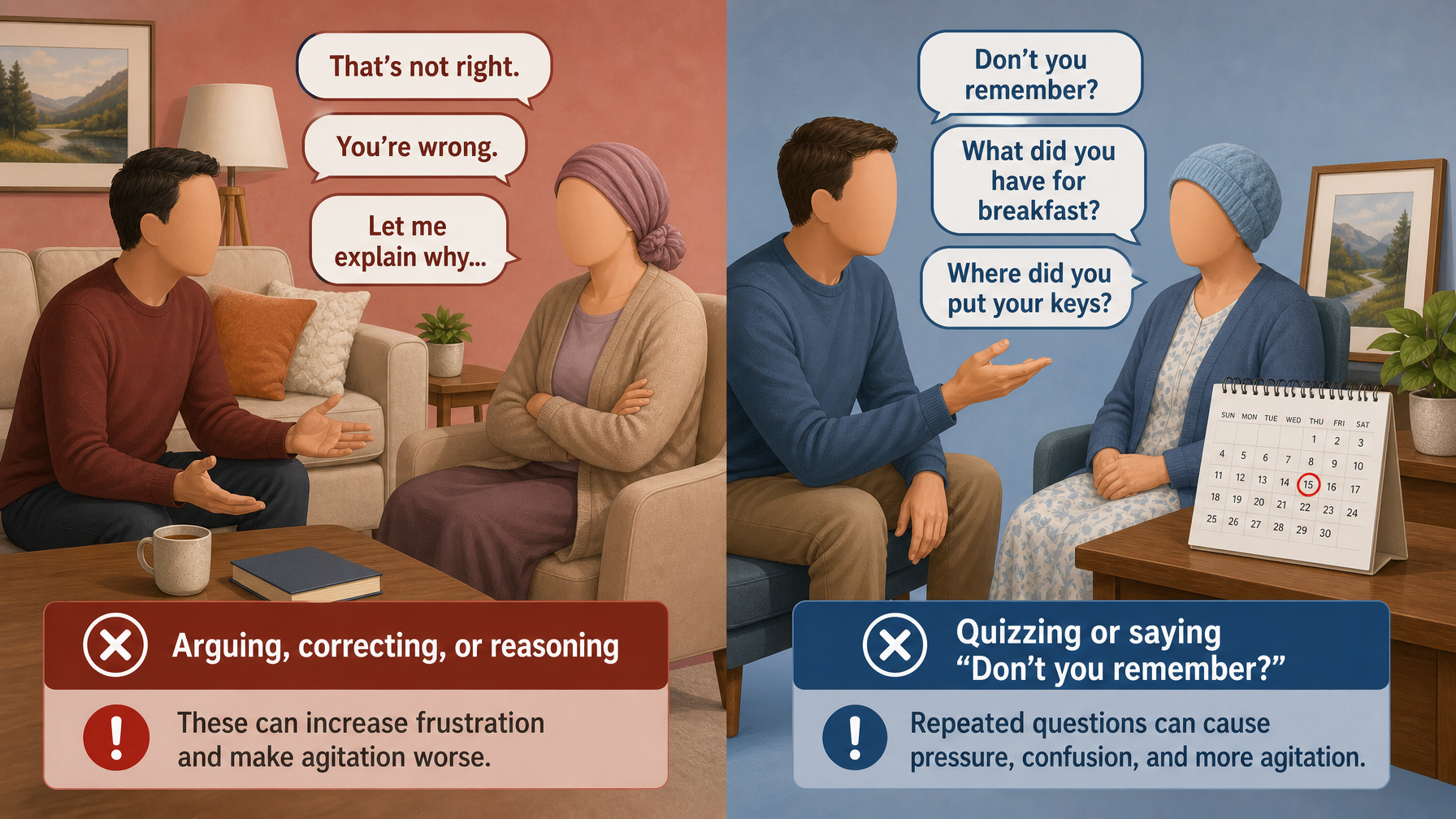
Some instinctive responses reliably make agitation worse. Try to avoid:
- Arguing, correcting, or reasoning — logic does not reach the distress and adds frustration.
- Quizzing or saying "Don’t you remember?" — this highlights loss and increases anxiety.
- Raising your voice or showing frustration — it amplifies their agitation through the emotional mirror.
- Restraining or forcing — physically forcing care or movement escalates fear; step back and try again later.
- Overwhelming with people, noise, or too many choices.
- Taking it personally — the disease is driving the behavior, not the person’s feelings about you.
Safety first
If agitation escalates to aggression that risks anyone’s safety, prioritize safety: give space, avoid cornering or restraining, and remove hazards. If you cannot keep everyone safe, seek urgent help. Ongoing or severe aggression warrants medical review.
Frequently asked questions
How do you calm an agitated dementia patient?
Stay calm yourself, since the person mirrors your tone. Validate the feeling behind their words rather than arguing or correcting, look for the trigger (pain, hunger, needing the toilet, fear, overstimulation) and meet that need, reduce stimulation, and gently redirect to a soothing activity, familiar music, or comfort. Avoid reasoning, quizzing, or restraining.
Why do dementia patients get agitated?
Agitation is communication of an unmet need the person can no longer express — commonly pain or discomfort, hunger, thirst, needing the toilet, tiredness, fear, loneliness, boredom, or overstimulation. A sudden change can also signal a treatable medical problem like infection, constipation, or a medication effect. Finding and meeting the cause usually eases the agitation.
Should you correct a dementia patient who is confused?
No. Correcting or arguing about facts they can no longer hold causes fresh distress and rarely helps. Instead, meet the emotion behind their words, reassure them, and gently redirect. Connecting with how they feel calms far more effectively than insisting on the facts.
What should you not do when a dementia patient is agitated?
Avoid arguing, correcting, or reasoning; quizzing or saying "don’t you remember"; raising your voice or showing frustration; restraining or forcing care; overwhelming them with noise, people, or choices; and taking the behavior personally. These responses amplify distress. Calm, validation, and redirection work far better.
What calms dementia patients down quickly?
A calm presence and reassuring tone, meeting an unmet need (toilet, food, comfort), familiar music from their youth, a soothing activity or comforting object, and moving to a quieter, less stimulating space. Which works best varies by person, so learn their preferences — but your own calm and validation are always the foundation.
When should sudden agitation in dementia be checked by a doctor?
When it is sudden, severe, or out of character, since that often signals a treatable medical cause — infection (such as a UTI), pain, constipation, dehydration, or a medication effect — rather than disease progression. Have it evaluated promptly. Ongoing or dangerous aggression also warrants medical review, with non-drug approaches tried first.
Sources
- National Institute on Aging (NIH). Managing Personality and Behavior Changes in Alzheimer's
- Alzheimer's Association. Anxiety & Agitation (behavioral symptoms and treatment)
- Clinical Infectious Diseases (Norman, 2000). Fever in the Elderly
- MedlinePlus (U.S. National Library of Medicine). Delirium
