
Elderly Suddenly Incontinent: What It Means and What to Do

Educational guidance, not medical advice. A sudden change in continence warrants prompt medical evaluation — this guide helps you recognize urgency and prepare.
When continence changes suddenly, it is almost always a sign of something specific — and often something treatable. Here is what a sudden change can mean, what needs urgent attention, and how to respond.
Key takeaways
- A sudden onset of incontinence is a medical red flag — the change itself points to a specific, often reversible cause.
- The most common culprit is a urinary tract infection, which in seniors often shows as new incontinence or confusion rather than classic symptoms.
- Other frequent causes: constipation, new medications, delirium, uncontrolled diabetes, and (in men) prostate problems.
- Some patterns are emergencies — inability to urinate, sudden incontinence with back/leg weakness or numbness, or with severe confusion — and need urgent care.
- The action is the same in almost every case: get it evaluated promptly rather than reaching straight for absorbent products.
Quick answer
What does sudden incontinence in the elderly mean?
A sudden loss of bladder or bowel control signals an acute, usually treatable problem — most often a urinary tract infection, but also constipation, a new medication, delirium, high blood sugar, or a prostate issue. Because the change is abrupt, the cause can frequently be reversed. Get a prompt medical evaluation; and treat it as an emergency if the person cannot urinate at all, or has new leg weakness, numbness, or severe confusion alongside it.
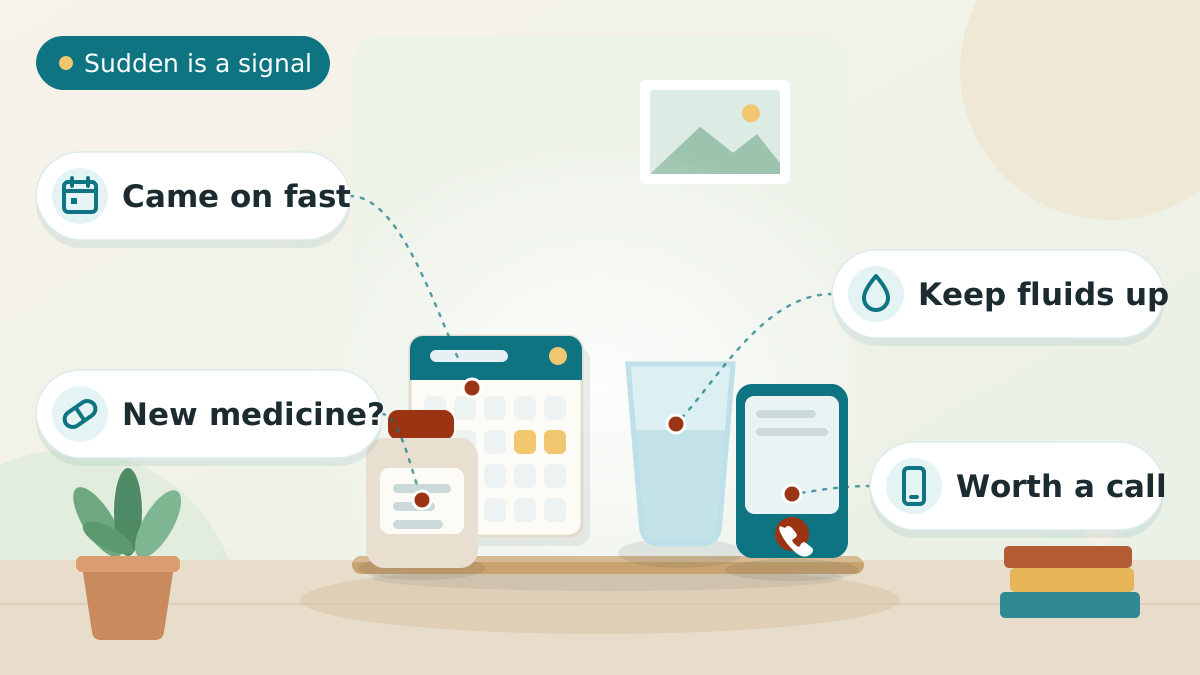
Why "sudden" changes everything
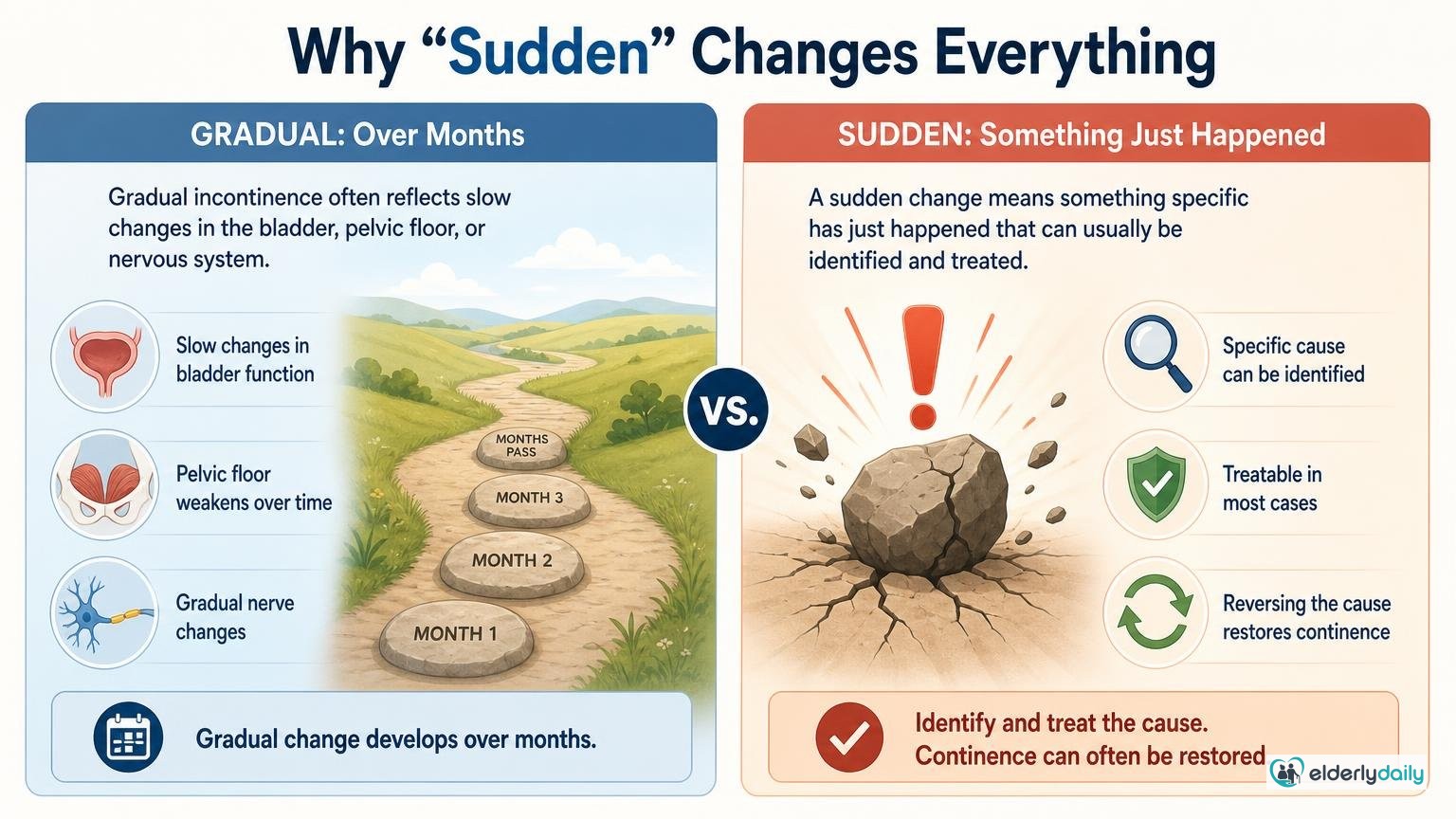
Gradual incontinence that develops over months often reflects slow changes in the bladder, pelvic floor, or nervous system. A sudden change is different — it usually means something specific has just happened, and that something can often be identified and treated. That makes sudden incontinence one of the more hopeful symptoms to investigate, because reversing the cause frequently restores continence.
The mistake to avoid is treating a sudden change as if it were simple aging and quietly starting absorbent products. That manages the symptom while missing an infection, a medication problem, or occasionally something serious. The right move is to find out why.
Do not wait for a fever
Many older adults never develop a fever even when seriously ill — fever is often absent or blunted in older adults with serious infection — it may be missing in roughly 20–30% (Norman, Clinical Infectious Diseases, 2000), and more often in sepsis, and an unusually low temperature can itself be a warning sign. Judge by the whole person, not the thermometer. New confusion, sudden weakness, not eating or drinking, a fall, or any sudden change from their usual self is a reason to seek care — even if the temperature is normal.**
The most common cause: a urinary tract infection

In older adults, a UTI is the classic cause of a sudden change — and crucially, it often does not present with the burning and urgency younger people get. Instead, the first signs in a senior are frequently new incontinence, new confusion or agitation, or a sudden decline in function. A parent who was fine last week and is now having accidents and seeming "not themselves" should be checked for a UTI early.
UTIs are straightforward to test for and treat, and treating one often resolves the incontinence entirely. Our UTI signs in seniors guide covers the atypical symptoms to watch for and when to seek care.
Watch out
Untreated, a UTI can progress to a kidney infection or sepsis, which is dangerous in older adults. New incontinence plus fever, back or side pain, or marked confusion warrants same-day medical attention.
Other common and treatable causes
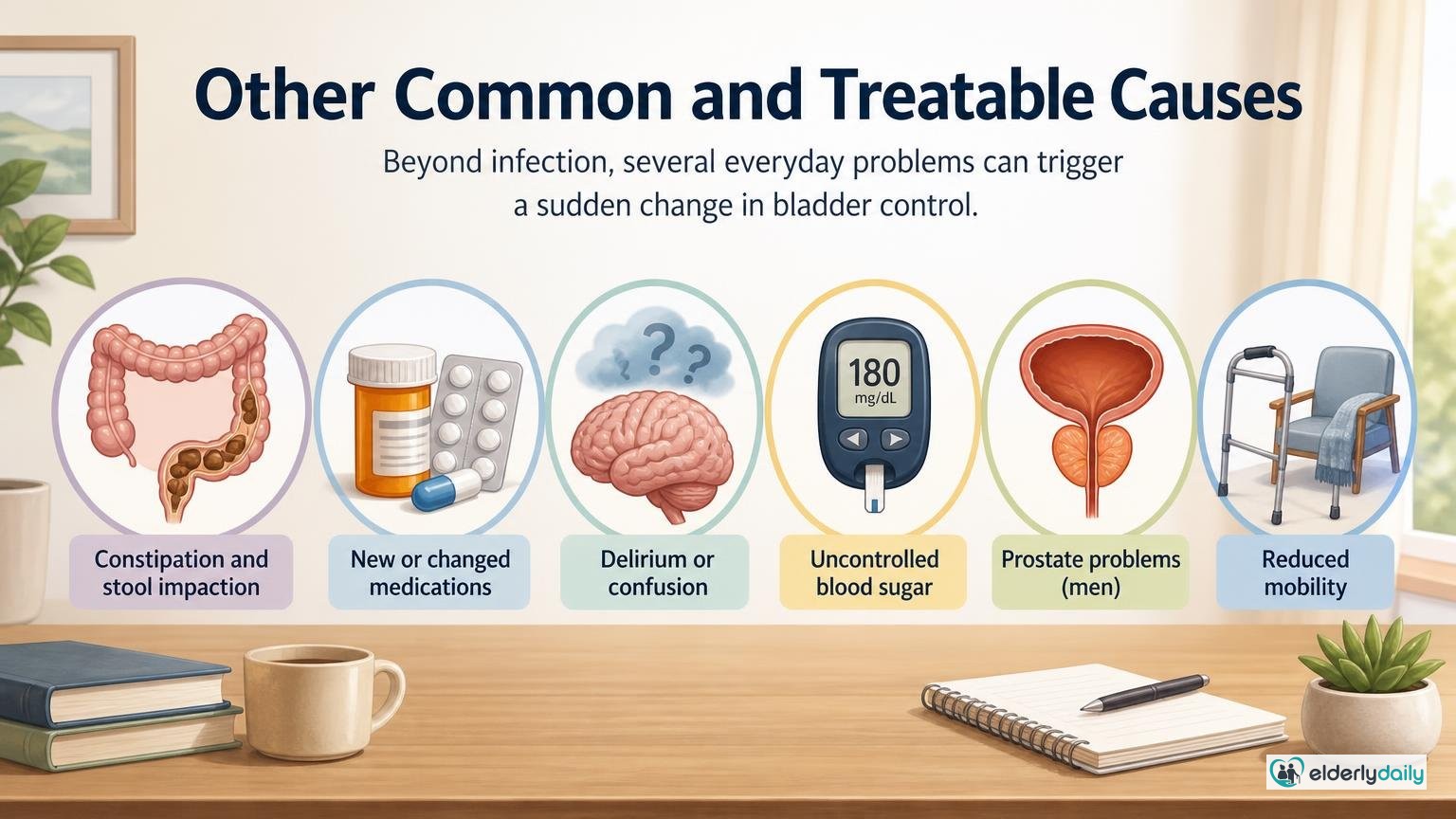
Beyond infection, several everyday problems trigger a sudden change:
- Constipation and stool impaction — a full bowel presses on the bladder, causing urinary leakage or retention, and can cause bowel leakage around the blockage. Very common and often overlooked; see bowel incontinence in elderly.
- New or changed medications — diuretics, sedatives, and others can suddenly affect bladder control. Review timing and options with the doctor or pharmacist.
- Delirium — an acute confusional state from infection, dehydration, or medication that disrupts the awareness and control continence needs.
- Uncontrolled diabetes / high blood sugar, which increases urine volume and urgency.
- Prostate problems in men — an enlarged prostate can cause sudden retention with overflow dribbling.
- Reduced mobility — if a new injury, weakness, or pain means they simply cannot reach the toilet in time. See why an elderly parent keeps falling and mobility aids.
When it is an emergency

Most sudden incontinence is urgent-but-not-emergency — see a doctor promptly. But certain patterns need immediate care. Seek emergency help if the sudden change comes with any of these:
- Inability to urinate, or only frequent small dribbles while the bladder feels full and uncomfortable (possible urinary retention).
- New weakness, numbness, or tingling in the legs, or numbness around the groin/saddle area — with new loss of bladder or bowel control, this can signal a spinal-cord emergency.
- Severe confusion, high fever, or signs of serious infection alongside the incontinence.
- Sudden incontinence after a fall or head injury.
Our incontinence warning signs and emergencies guide details these red flags. When in doubt, it is always safer to be seen.
Safety first
New loss of bladder or bowel control together with leg weakness or saddle-area numbness is a medical emergency (possible cauda equina or cord compression). Do not wait — seek emergency care immediately.
What to do right now
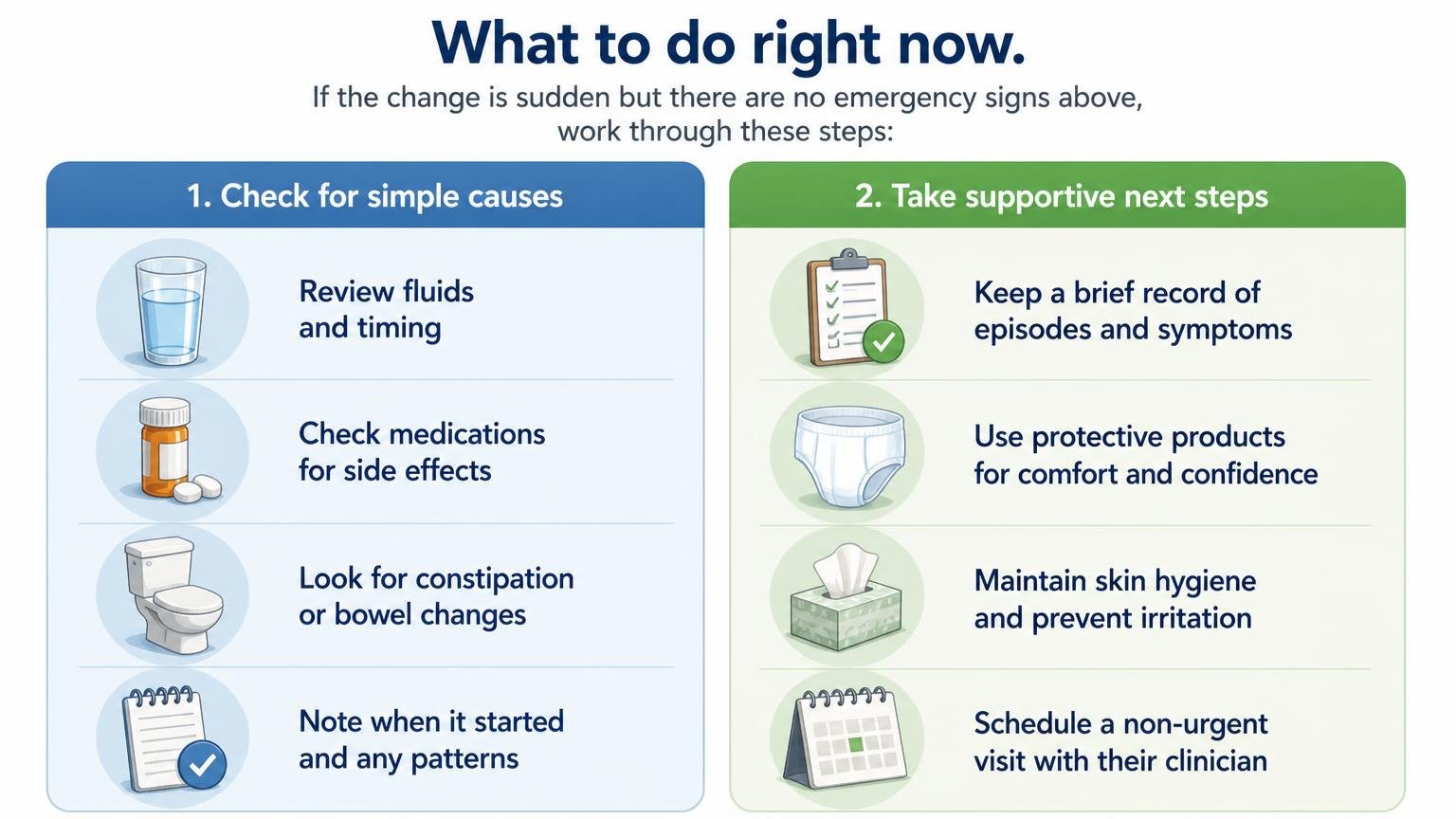
If the change is sudden but there are no emergency signs above, work through these steps:
- 1
Note when and how it started
Record the timing, any pattern, and other new symptoms (confusion, fever, pain, new medication). This is exactly what the doctor needs.
- 2
Check for the obvious
Consider recent medication changes and when they last had a proper bowel movement — constipation is a frequent, fixable trigger.
- 3
Arrange a prompt medical review
Call the doctor and describe it as a sudden change; ask specifically about a urine test for infection. Our talk to a doctor about incontinence guide helps you get the most from the visit.
- 4
Manage kindly in the meantime
Use absorbent products and protect the skin and bed while you await evaluation — see managing incontinence at home — but treat this as a bridge, not the solution.
- 5
Watch for escalation
If emergency signs appear — retention, leg weakness, severe confusion, high fever — switch to urgent care.
After the cause is treated
When the underlying cause is addressed — the infection cleared, the constipation relieved, the medication adjusted — continence often returns to its previous baseline. If it does not fully recover, or if this was the first sign of an ongoing issue, move into a management routine and keep the doctor involved.
If a hospital stay was part of the picture, incontinence can be temporary and improve with recovery — see temporary incontinence after hospitalization. And if changes keep recurring, our signs incontinence is getting worse guide helps you judge when to escalate.
Frequently asked questions
Why did my elderly parent suddenly become incontinent?
A sudden change usually signals a specific, often treatable cause — most commonly a urinary tract infection, but also constipation, a new medication, delirium, high blood sugar, or a prostate problem. Because the onset is abrupt, treating the cause frequently restores continence. It should be evaluated promptly rather than simply managed with products.
Can a UTI cause sudden incontinence in the elderly?
Yes, very commonly. In older adults a UTI often shows up as new incontinence or new confusion rather than the classic burning and urgency. A senior with a sudden change in continence should be checked for a UTI early, as treating it often resolves the incontinence.
Is sudden incontinence an emergency?
It can be. Seek emergency care if the person cannot urinate at all, has new leg weakness or numbness (especially around the groin), has severe confusion or high fever, or became incontinent after a fall or head injury. Otherwise it is urgent but not an emergency — see a doctor promptly.
Can constipation cause sudden incontinence?
Yes. A full or impacted bowel presses on the bladder, causing urinary leakage or difficulty emptying, and can cause bowel leakage around the blockage. It is a frequent and easily missed cause, so checking when the person last had a normal bowel movement is worthwhile.
Will the incontinence go away once the cause is treated?
Often, yes. When the underlying trigger — infection, constipation, a medication — is treated, continence commonly returns to its previous level. If it does not fully recover, it moves into ongoing management with continued medical follow-up.
What should I do first if my parent suddenly loses bladder control?
Note when and how it started and any other new symptoms, check for recent medication changes and constipation, and arrange a prompt medical review — asking specifically for a urine test. Use absorbent products and protect the skin while you wait, and switch to urgent care if emergency signs appear.
Sources
- Clinical Infectious Diseases (Norman, 2000). Fever in the Elderly
- MedlinePlus (U.S. National Library of Medicine). Delirium
- American Association of Neurological Surgeons. Cauda Equina Syndrome
- CDC. About Sepsis
